
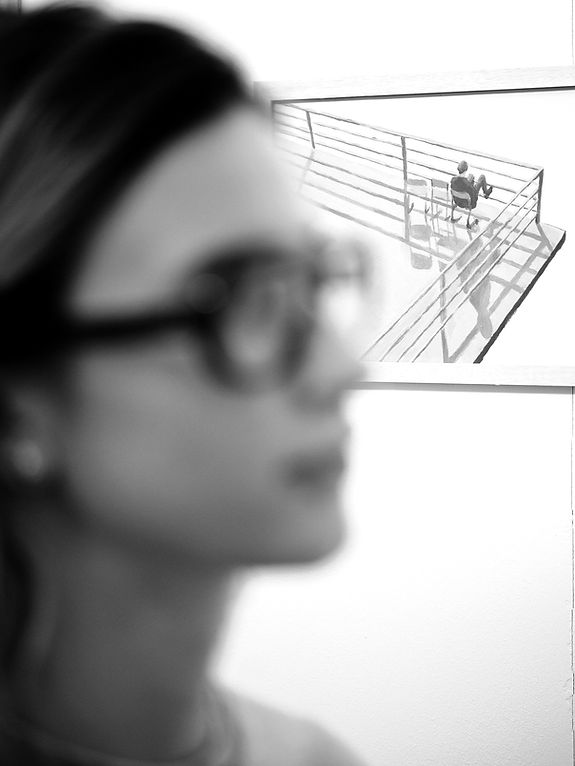
© Photo Marc Medina
SWAB DIRECTOR
CAROLINA DÍEZ-CASCÓN
ON RETHINKING THE ART FAIR
In dialogue with Carolina Díez-Cascón
FVTVRIST Magazine // October 1, 2026
The art fair has long been one of the contemporary art world's most visible architectures: a place where artistic production, institutional attention and market value converge. As the structures surrounding art become increasingly unstable and younger artists, curators and galleries invent new ways of working, the question has turned to what an art fair is capable of sustaining.
Swab Barcelona has been dedicated to emerging art since 2006. Its founder, collector Joaquín Díez-Cascón, handed the direction of the fair to his daughter Carolina in 2025. An artist and collector herself, she also co-directs the film production company Cantic Films and teaches art market and curatorial studies at universities in Catalonia. Under her direction, Swab takes the eclipse as its metaphor for 2026, a way of thinking about shifting visibility, inherited hierarchies and what remains outside the art world's established field of attention.
As Swab approaches its twentieth anniversary, FVTVRIST speaks with Carolina Díez-Cascón about what the contemporary art system overexposes, why artist-run and independent spaces are moving towards the centre, how the meaning of collecting is changing, and what an art fair must become if it is to remain culturally relevant in the decades ahead.

Portrait of Carolina Díez-Cascón. © Photo Alfonse Chiu.

Swab was founded by your father, Joaquín Díez-Cascón, in 2006, and you have described growing up alongside the fair before taking over its direction in 2025. What have you changed at Swab since becoming director?
One of the most meaningful aspects of Swab is that it is a family project, born from a genuine passion for art. Art evolves alongside society and responds to its transformations, and this is particularly visible in emerging practices, which often reflect social, economic and political shifts as they are happening.
Over almost twenty years, Swab has witnessed these changes from within. In a way, the transition from my father’s direction to mine is also part of this evolution: a generational shift that mirrors the transformations taking place across the artistic ecosystem itself.
When my father conceived Swab, the context was very different. Today, the fair is changing together with the spaces, galleries and artists that constitute it. Rather than imposing a new model, my approach has been to listen to these practices and allow the fair to adapt around their evolving realities and needs.
The market has also changed significantly. For a younger generation of artists and independent spaces, the urgency today is not simply to gain visibility, but to build a solid and sustainable ecosystem around their practices. This is where I see Swab’s role now: to place the fair at the service of that ecosystem, creating the conditions, connections and structures that can help it grow and sustain itself over time.
TODAY, THE FAIR IS CHANGING TOGETHER WITH THE SPACES, GALLERIES AND ARTISTS THAT CONSTITUTE IT.
This year's metaphor is the eclipse: a temporary shift in what is visible and what is obscured. Emerging art has always depended on visibility, but visibility today is increasingly produced by algorithms, fairs, institutions and market attention. What do you think the contemporary art system is currently overexposing, and what practices, geographies or ways of working are still sitting in its blind spot?
For us, the eclipse represents a moment of transition. In the art world, this means questioning and leaving behind inherited patterns, particularly those imposed by the market and by Western modernism conceptions of what contemporary art should be, how it should circulate, and where its value should reside.
We are into a period of adjustment in which these established hierarchies are being challenged. What has been historically overexposed are certain models of success, visibility and value understood as economic gain, while other geographies, independent structures, collective practices and ways of producing and sustaining art have remained outside the main focus.
The eclipse allows us to think about shifting that focus: bringing different practices and contexts onto the same plane, reducing the distance between sectors, and encouraging solidarity and stronger connections across the artistic ecosystem.
At a moment of profound social transformation, it is especially urgent that the humanistic dimension of society is not left behind. Art needs to remain connected to society and actively engaged with the realities shaping it, from technological dehumanization to genocide, inequality and abusive political structures. For us, the question of visibility is therefore not only about who or what is seen, but about what kind of ecosystem we want to build around art, and what role art can continue to play within society.


Swab Barcelona 2025. Photo: Marc Medina.
© Courtesy of Swab Barcelona.
Independent and artist-run spaces have moved much closer to the centre of Swab under your direction. How do you bring independent practices into the market?
Rather than being a specific intention of Swab, I think these spaces have naturally gained a new dimension because of the circumstances in which younger generations are developing their practices today.
Opening and maintaining a traditional gallery now involves costs that are increasingly difficult for one person to sustain. This has led artists, curators and cultural workers to come together in collectives, sharing resources and responsibilities, while developing alternative structures that allow their projects to survive and grow.
What I find particularly interesting is that these spaces often create a very different balance between artistic creation, research and the market. These dimensions are no longer necessarily separated, but become part of the same ecosystem: research can generate artistic projects, collective structures can create new forms of circulation, and the market can become one of several tools that help sustain them.
Their growing presence at Swab therefore reflects a broader reality. They are not simply alternative spaces operating outside the market, but new models that are experimenting with how artistic practices can be produced, shared and sustained. In many ways, this hybridity responds directly to the economic and social urgency facing a younger generation today.
OFF-SITE brings together galleries that propose new kinds of spaces for art, spaces that in turn shape how they curate. Running an unconventional space carries real costs and risks. How does Swab select these galleries, and what does the programme give them in return for bringing that experimentation into the fair?
Through this programme, we aim to give visibility to alternative ways of conceiving and developing an artistic project, particularly in relation to physical space. At a time of growing housing and real-estate precarity, younger generations face increasing difficulties in finding the conditions and spaces needed to initiate and sustain their projects. At the same time, this reality is accompanied by an increasing mobility among young people, whose lives and practices often move between cities and countries.
In this context, it becomes important to explore new approaches to space, particularly through the reuse and activation of disused or overlooked sites within the city, but also through more nomadic models that can adapt and relocate. Projects such as Outhouse, which transforms a former public toilet, or Alkovi, which operates from a street-facing shop window, demonstrate how spaces originally conceived for entirely different purposes can become sites for artistic production and encounter. Suvatne introduces another model: a nomadic project that moves between countries, reflecting the mobility that increasingly shapes the lives and practices of younger generations.
The programme also seeks to challenge established ideas of what an exhibition space should look like and how it should function. CasCaDas, for instance, inhabits a former haberdashery, while Etheral Maison, no longer tied to a permanent physical venue, develops pop-up projects in public and unconventional spaces, including churches.
Rather than understanding the lack of a conventional or permanent space solely as a limitation, these projects reveal other ways of inhabiting the city and sustaining artistic practices. Through reuse, mobility and adaptation, existing structures and temporary spaces can acquire new forms of cultural life.
Swab was founded by a collector and has always positioned itself close to a new generation of collecting. Are you a collector yourself? What makes someone want to become a collector today, and do you see the idea of collecting changing with your generation?
Yes, I am a collector and I have my own collection. It is true that collecting is, in many ways, something that can be inherited. From a very young age, I accompanied my father, and through him I gradually learned how to look at art and developed my own curiosity. But I also had my own collections as a child, as many collectors do: stickers, marbles, trading cards and small objects that, for whatever reason, you feel the need to keep, organise and connect.
I think there is something very instinctive about collecting, a curiosity or passion that lies dormant in some people. Sometimes it simply needs an encounter, with an artwork, an artist or a particular context, to activate that connection.
At the same time, I think the meaning of collecting is being questioned by my generation. We live in a society that is increasingly concerned with letting go of things, whether for economic, spatial or even spiritual reasons. So the idea of accumulating and possessing objects inevitably needs to be reconsidered.
For me, collecting today is increasingly about commitment to culture. This is also changing the role of the collector: beyond acquiring artworks, collectors can become more actively involved in sustaining the ecosystem, supporting artists and independent spaces, enabling projects, and participating in networks of solidarity. In this sense, collecting becomes less about ownership and more about responsibility, participation and the relationships we build around art.
Swab turns twenty next year. What do you want Swab to become over its next twenty years; and what do you think an art fair will need to be in order to still matter twenty years from now?
I hope Swab can continue to be a free and independent fair, a platform that gives voice to new generations of artists and contributes meaningfully to culture and society as it evolves alongside them.
Looking towards the next twenty years, I would like it to remain a place for exchange, learning and debate, a space where different parts of the artistic ecosystem can meet, share with one another and build stronger connections.
I think this is also what art fairs will need in order to remain relevant. They cannot simply be places where art is exhibited and sold; they need to participate in sustaining a living cultural ecosystem and create meaningful connections between artists, galleries, independent spaces, institutions, collectors and the wider public.
Ultimately, I hope Swab continues to bring art closer to society, helping people recognize the importance and transformative power of culture and encouraging a shared responsibility for sustaining it, not only financially, but also through time, knowledge, care and other resources each of us can contribute. If we can preserve that openness and remain responsive to the realities of each generation, I believe the fair can continue to play a meaningful role in the future.
ART FAIRS NEED TO PARTICIPATE IN SUSTAINING A LIVING CULTURAL ECOSYSTEM, CREATING MEANINGFUL CONNECTIONS BETWEEN ARTISTS, GALLERIES, INDEPENDENT SPACES, INSTITUTIONS, COLLECTORS AND THE WIDER PUBLIC.


1/ divergenX, MyFAF. © Courtesy of divergenX and Swab Barcelona.
2/Temporary Address, Independent. © Courtesy of Temporary Address and Swab Barcelona.
3/Bacio Collective, General Program. © Courtesy of Bacio Collective and Swab Barcelona.
4/AllAllAll, Polar Tropic. © Courtesy of AllAllAll and Swab Barcelona.
5/ATM. © Courtesy of ATM and Swab Barcelona.
6/Trastienda Machete Galería, Vortex. © Courtesy of Trastienda Machete Galería and Swab Barcelona.
About Carolina Diez-Cascón
Carolina Díez-Cascón is the director of Swab Barcelona. Trained in design at IED and in the art market and curatorial practice at institutions including Sotheby’s and the Royal College of Art, her work moves across contemporary art, moving image, cultural production and education. She has produced installations and video works presented at institutions including Arts Santa Mònica and CCCB, and co-directs Cantic Films, a production company developing collective film projects with different communities. Alongside her role at Swab, Díez-Cascón teaches art market and curatorial studies at universities in Catalonia.
About SWAB Art Fair
Founded in 2006 by architect and collector Joaquín Díez-Cascón, SWAB Barcelona began with a clear proposition: to bring emerging international practices into dialogue with Barcelona's cultural scene and to make the contemporary art fair a more open, accessible format. Since 2025, under the direction of Carolina Díez-Cascón, that proposition has expanded towards independent spaces, collective practices and alternative models of exchange, while retaining the fair's focus on emerging artistic production and new collecting.
For its 19th edition, SWAB turns to a question increasingly difficult for contemporary art fairs to avoid: what constitutes value beyond the market? The 2026 programme considers artistic value through social, symbolic and collective perspectives, looking at the tension between the economic structures of the art system and the experimental, autonomous and collaborative practices developing within it. More than 60 galleries, independent spaces and curatorial projects from 24 countries participate across the fair's programmes, alongside performances, workshops, radio, encounters and other public formats.
Taking place at the Palau Victòria Eugènia at Fira Barcelona Montjuïc, the 2026 edition also expands beyond the conventional booth through initiatives including the new OFF-Site programme, which activates peripheral, reused and unconventional spaces and considers how contemporary practice can form different relationships with territory and its communities.
FVTVRIST joins SWAB Barcelona 2026 as an official media partner. Across the fair, our editorial programme will focus on selected artists, galleries and independent projects through interviews, studio-led conversations and critical features, looking beyond individual works to the practices, infrastructures and ideas shaping a new generation of contemporary art.


%203.jpg)


