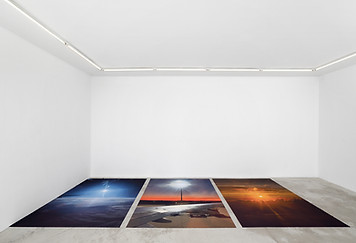
© Photo Miguel Mendez
ALBA FABRE HAS SOMETHING TO SHOW YOU
In dialogue with Alba Fabre
FVTVRIST Magazine // October 1, 2026
This year, Escat Gallery brings Alba Fabre to SWAB Barcelona 2026 as one of the artists at its booth (Booth G28). Painting sits at the centre of the presentation, though Fabre's relationship with the medium has never stopped at the canvas. Her murals stretch from Kosovo and Beirut to Brussels, Gallipoli and a village in Extremadura. The list reads almost like a travel diary. Ahead of the fair, FVTVRIST talks to the Barcelona-born painter about bodies and who gets to look at them, erotic images that feel more violent than sexy, censorship and the quieter self-censorship that follows, and a practice that moves between the canvas and the street.

Portrait of Alba Fabre. © Photo Laida Zapre
Kosovo, Beirut, Brussels, Gallipoli, a village in Extremadura, and many more. Your list of murals reads like a travel diary. Yet public space is never entirely free. There is always a commission, an institution, a permit, someone who ultimately says yes or no. You have spoken about censorship and the quieter self-censorship that follows it. What image are you still waiting for a wall brave enough to hold?
I like this question because I’m always hoping someone will ask me so that maybe I can finally find a wall where I can do it. Ever since I started painting murals, almost seven or eight years ago, I’ve wanted to paint a large façade depicting a vagina, with no erotic connotation whatsoever. And to this day, I haven’t been able to do it. I haven’t found the right wall. I’ve tried in several countries, and every time I go to a mural festival, wherever I am, I ask about it, but so far it hasn’t happened.
I should clarify that I’m talking about doing it legally. Obviously, I could do it illegally, but my intention is to do it legally, on a large wall, in a visible place. In fact, I have a little anecdote about this. Earlier this year, in January, I was in Italy and met Stefania Dubla, who organises mural projects there. We had already worked together on a project, and six years ago, when I went to paint a mural in a very small village in Basilicata, I had already told her about this idea. Then, this year, she called me because she had found a wall where we could finally do it.
But the wall she had found was inside a public compound, so although it was technically in a public space, the mural wouldn’t actually be visible from the outside. You would have to enter the compound to see it. And on top of that, the politicians wanted the mural to remain covered. Precisely because of what I was talking about, I decided that it wasn’t the right place for this project. I don’t want to paint this image only for it to be hidden away.
In the end, what we did was a mural of a girl sitting on a man’s face, which was an erotic image. And in that case, it didn’t bother me as much as having to hide a painting of a vagina simply because it was a vagina. So I’m still waiting for the right wall: a large, visible wall, where I can paint it legally and simply show this part of the body for what it is — a part of the body, as a portrait, nothing more.
Closed eyes, a kiss, bodies cut, layered and reassembled like pages torn from a private magazine. A queen on her throne, two nude women holding hands like a tiny talisman. Whose memories are we looking at: yours, someone else's, or ones you invented through painting?
The memories are actually fragments from magazines that I’ve been buying and using as references. Coming from a classical painting background, I’ve always been very familiar with the nude body as a reference, and it’s something I’ve worked with throughout my practice.
In fact, I often find the visual language and editorial style of magazines from the 1980s and 1990s much more interesting than what we see today. I started cutting up these magazines because those images produced a huge sense of violence in me. They were supposed to be erotic magazines, but for me, they had the opposite effect. I found them extremely violent — not necessarily because of their physical intensity, which can be exciting when there is consent, but because of the deeper sense of something that hurts.
So, the way I selected the images was actually by keeping the ones that produced the least violence in me, or at least the ones that felt less harmful. And as a result, some of them felt erotic to me. That eventually became part of my work.
It wasn’t about choosing images that aroused me or that I connected with sexually. It was actually the opposite: I was keeping the images that produced the least violence in me. And through that process, those fragments gradually became part of my paintings.


1/ Escat Gallery
2/ Installation view, Una habitació pròpia, Escat Gallery, Barcelona, 2026
3/ Alba Fabre; Untitled, 2025
© Courtesy of the artist and Escat Gallery.
You spent years in Barcelona studying and later teaching classical painting and drawing. What shaped your visual world during those years, and where do you find inspiration now? Do you still see the body through that academic training, or have you had to unlearn parts of it?
Light and colour became extremely important in my visual world during those years, and they are still very present in my work today. Being able to explore how an abstract language can be represented through form, colour and light was something quite magical for me, and I still hold on to that sense of wonder in my painting.
And yes, I still see the body through that academic training. When you study painting, you are learning a language — you learn what has been done before. So when I look at a body, I’m also seeing it through that learned language. I see structures, colours, contrasts, forms and shapes, but those ways of seeing have already been defined and developed before me.
I think what I’ve had to do is try to connect that language more with my own abstraction and my own way of seeing, and it will take my entire career to pursue it. I’m not trying to get away from what I’ve learned, because that language is part of my way of working, but rather to make it my own and to see what happens when I apply it to the way I personally perceive what I’m looking at.
Una habitació pròpia, a title that refers to Virginia Woolf’s A Room of One’s Own. After years of negotiating public space, the easel offered a different kind of autonomy. How has that shift transformed your pictorial language, and what are you allowing into the work now that you once held back?
Actually, the easel came first, and then painting in public space. So I suppose the difference is that, easel painting allows me to investigate what interests me without having to take into account, for better or worse, the fact that someone is going to encounter the work whether they want to or not.
That allows me to focus more on my own way of working and on my own research, without having to think so much about how the image is going to exist within someone else’s everyday environment. Public space is different because the work becomes part of a place that people already inhabit, whether they have chosen to see it or not.
Swab has always championed emerging practices, experimentation and galleries working beyond conventional fair structures. Where does your practice sit within that context, and does this presentation with Escat Gallery feel like a new chapter for you?
-
Yes, I’m really excited to be taking part in Swab, especially because I’ve been to the fair several times before. Since I’m from Barcelona, it was a place I used to come to see other artist friends, to discover what was happening in the contemporary painting scene, and to get a sense of what was going on in the city.
What I value about working with Escat Gallery is that there is a genuine dialogue around the work. From the beginning, I felt that they were genuinely interested in my practice and understood where the work comes from, but also where it can go. There is trust, and that gives me the freedom to keep developing the work rather than adapting it to a particular expectation.
I also feel a strong connection with some of the artists in the gallery’s programme. Vivian Alarcón, who will also be presented by Escat at Swab, is an artist whose work I really admire. Our practices are very different, but I think there are certain shared sensitivities. So it feels very natural to me, and I’m really happy to be presenting my artworks at SWAB with them.
Barcelona is where you learned to paint, where you taught, and where your visual language began. Does showing in your hometown feel different? And in a space as monumental as the Palau Victòria Eugènia, how does the architecture enter into conversation with your work?
Showing the work in Barcelona feels very special to me. There is a sense that is more in tune, and I think that becomes even more noticeable when I’m actually making the work. I have a sense of how the work might be received. Whether people like it or not, I feel that there is always a certain warmth in the way it is received, and that makes the experience different for me.
As for the space itself, the venue where Swab takes place is so large that it can actually feel a little desolate. And because there are so many galleries with different paintings, whenever I’ve been there, I’ve found it quite overwhelming in terms of stimulation, but at the same time there’s this slightly desolate feeling to the space. So perhaps, my work will simply add a little more noise to the room.
A mural meets people by accident. At an art fair, everyone arrives already looking for art. What kind of encounter are you hoping your work creates at Swab?
Yes, you’re right to put it that way. I hadn’t really thought about it before, but perhaps it comes from my experience with murals, where people simply come across the work. I don’t really expect anything specific from that encounter. In the end, the way someone perceives a work depends a lot on them: on their own interests, their tastes, and so on. I would be happy if someone connected with my work, simply connected with my sensitivity, and that’s about it, really.
Sometimes, even if a mural is there, you don’t actually look at it. You might just walk past it without noticing it. So as you said, I suppose that’s where the difference with a fair comes in: people go to an art fair because they want to see art. But at the same time, I think something similar happens. People will naturally notice the things they connect with more, while the things that don’t speak to them will probably just pass them by at least that day, or in that particular moment. I’m also curious to see how people respond to my artworks within Escat Gallery’s presentation alongside other artists.

Alba Fabre, mural, 2026. Art City Bologna 2026, Centro Sociale 2 Agosto, Bologna, Italy. Organised by Maap Arte Pubblica.
© Courtesy Alba Fabre and Maap Arte Pubblica.


Alba Fabre
1/ Ella misma es una pintura, 2026
2,3/ Edad legal, 2025
© Courtesy of the artist and Escat Gallery.
About Alba Fabre
Alba Fabre (Barcelona, 1994) trained for years in a rigorous academic setting in painting and drawing in Barcelona, where she also taught for several years. Fabre now works independently from her own studio, focusing exclusively on her artistic practice.
Since 2020, she has ventured into contemporary muralism, standing out for a strictly pictorial language, without references to graffiti or street art, rethinking the mural as a medium linked to the tradition of painting. Her practice develops between the public dimension of murals and the economic dependence on festivals and institutional commissions, which shape both her possibilities and limitations.
Internationally recognized for her representations of the human figure and organic forms, sometimes evoking an impressionist sensibility, Fabre has faced censorship and self-censorship. This has led her to explore easel painting as a space for expressive autonomy, free from institutional or administrative agendas.


About SWAB Art Fair
Founded in 2006 by architect and collector Joaquín Díez-Cascón, SWAB Barcelona began with a clear proposition: to bring emerging international practices into dialogue with Barcelona's cultural scene and to make the contemporary art fair a more open, accessible format. Since 2025, under the direction of Carolina Díez-Cascón, that proposition has expanded towards independent spaces, collective practices and alternative models of exchange, while retaining the fair's focus on emerging artistic production and new collecting.
For its 19th edition, SWAB turns to a question increasingly difficult for contemporary art fairs to avoid: what constitutes value beyond the market? The 2026 programme considers artistic value through social, symbolic and collective perspectives, looking at the tension between the economic structures of the art system and the experimental, autonomous and collaborative practices developing within it. More than 60 galleries, independent spaces and curatorial projects from 24 countries participate across the fair's programmes, alongside performances, workshops, radio, encounters and other public formats.
Taking place at the Palau Victòria Eugènia at Fira Barcelona Montjuïc, the 2026 edition also expands beyond the conventional booth through initiatives including the new OFF-Site programme, which activates peripheral, reused and unconventional spaces and considers how contemporary practice can form different relationships with territory and its communities.
FVTVRIST joins SWAB Barcelona 2026 as an official media partner. Across the fair, our editorial programme will focus on selected artists, galleries and independent projects through interviews, studio-led conversations and critical features, looking beyond individual works to the practices, infrastructures and ideas shaping a new generation of contemporary art.


_2025_102%20x%2091%20cm_1.jpg)