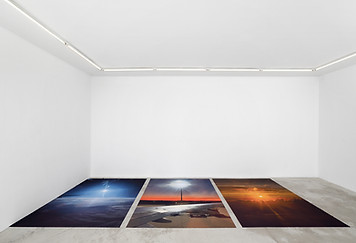
THE GROUND TO MAKE THINGS
In dialogue with Thomas Liu Le Lann
FVTVRIST Magazine // Text by Anna S.
13 June 2026
Thomas Liu Le Lann is a finalist for the Swiss Art Awards 2026, the exhibition opening 15 June and running 16 to 21 June in Hall 1.1 at Messe Basel, the country's oldest art prize staged in the same building, the same week, as Art Basel, 18 to 21 June. The work he is bringing there is The Best Is Yet to Come, a 28-minute video in which a recovery testimony, four years of his own abstinence, is recited by a seven-year-old and a twenty-year-old, the words passing through two bodies they do not belong to.
We spoke with the artist about objects that stop doing their job, boxing gloves too heavy to wear and too fragile to hit, and the work he is bringing to Basel 2026.

Thomas Liu Le Lann, portrait. PH: Kostromin Alexey .
© Courtesy of FVTVRIST.

Mort le Soleil, 2024. Floor lamps, powder-coated steel, flashlights, cables, plastic. Variable dimensions.
© Courtesy of Xippas Gallery.
Your recent work introduces stainless steel, manganese steel, engraved blued carbon blade. These are the hardest, most specifically dangerous materials in your vocabulary to date (objects that cut rather than cushion). The Training boxing gloves have moved from pink glass to black lacquer across Parts VII and VIII. Something is sharpening. What shifted?
I wouldn't describe it as a shift so much as a loss of distance. Things that were already present in the work are now harder to soften, harder to disguise. I've long been working with objects coded as protective, functional, or authoritative, and displacing them until they start to misbehave. In Mort le Soleil, Maglite flashlights associated with police, security, and emergency response become almost domestic lamps, fixed on stands and plugged into the grid. But they remain harsh, directional, too convinced of themselves. They point at nothing. They perform authority after authority has left the room.
The cutter brings it into your hand: small, engineered, with TRUST ME engraved on the blade. A strange kind of promise — confidence asked for by something that can wound you. The work is also an edition: a boxed object, closed with nylon zip ties, accompanied by a large poster with a pattern to cut out one of my Soft Heroes, the phrase GET A LIFE, and a short text that reads like unstable instructions:
A cutter.
To open a box,
To slice a grip,
To sever anything lifeless,
Or perhaps, to end it all.
Language frames the object without resolving it: part tool, part prop, part threat. Useful, obedient, theatrical.
With the boxing gloves, the image is familiar: gloves hanging in a locker room: training, endurance, masculinity, impact. But here, they fail beautifully. Too heavy to wear, too fragile to hit, they keep the costume of power, but not the job description. The combat remains as a form, without release. In Training Part VIII, one glove is dense, opaque black glass; the other translucent, laced with grey and black inclusions, a suspended, petroleum-like mass. In Training Part IX, one glove is opaline pink, the other translucent and tinted in the mass, both hot-crackled and stabilized through annealing. The color feels unstable, like makeup at the end of the night. The cracks remember the drama.


1/ Thomas Liu Le Lann, The first cut is the deepest, 2025. PH: Jiawei Zou
© Courtesy of Jakob Collection.
2/Onelife, 2024. Stainless steel cables, garments, 300 × 710 × 50 cm. PH: Julien Gremaud.
© Courtesy of Xippas Gallery.

Thomas Liu Le Lann, Bubble_anel.exe, 2026.
© Courtesy of the artist.


Training Part Series
1,2/ Xippas Gallery, Thomas Liu Le Lann, 2025
Photography: Julien Gremaud.
3/ Grants of the City of Geneva, Centre d’Art Contemporain, Geneva, 2023
Photography: Jannik Wetter.
© Courtesy of the artist and Xippas Gallery.
Bubble_angel.exe reads like a character file — a 3D render or gacha figure translated into blown glass. The title carries a file extension, which is unusual for a handmade object. What is the relationship between that digital register and the craft process? Are you interested in objects that look like they should not exist as physical things?
.exe suggests something executable — a file meant to trigger an action. It carries a sense of latency, of something waiting to be activated, sometimes by accident. I was interested in bringing that logic into an object that clearly cannot "run" anything. Bubble_angel.exe looks like it could belong to a digital environment: a character file, a low-resolution mascot, somewhere between a game asset and a protective avatar.
The figure is deliberately unstable. It borrows familiar codes: a helmet, wings, a compact body, but none of them fully function. The wings are too small to lift, the helmet too large, the body too condensed. It's not a character, not quite a mascot, not quite a relic. It holds several intentions without resolving into a clear identity.
The angel is not a symbolic figure to me. It's closer to an interface or a relay, something between states, between systems. I'm interested in objects that feel like they shouldn't quite exist as physical things — not as a contradiction or a gimmick, but as a way to keep them slightly out of place, slightly unassigned. The work stays in a kind of pre-operational state: formed, maybe ready, but without a clear function to execute.
Onelife hangs actual garments on stainless steel cables across the full width of the gallery windows — clothes that seem to be neither displayed nor stored, caught between use and archive. This feels different from the Soft Heroes, who are sewn and filled. These are real garments, found or worn. Whose clothes are these, and what does it mean for clothing to be suspended rather than inhabited?
Onelife hangs actual garments on stainless steel cables across the full width of the gallery windows: clothes that seem to be neither displayed nor stored, caught between use and archive. This feels different from the Soft Heroes, who are sewn and filled. These are real garments, found or worn. Whose clothes are these, and what does it mean for clothing to be suspended rather than inhabited?
The work uses real garments: technical clothing associated with specific functions: cooking, care, construction, maintenance. These are clothes designed to do something, to protect, to perform a task. Here, they are suspended across the windows like laundry, but also like a stage.
Unlike constructed figures, these garments already have a history. But once suspended, they start to shift register. They become closer to costumes, or maybe the remains of a role.
In the same room, I also showed photographs of figurines: superheroes, film characters, small iconic bodies from popular culture. So the garments were placed in relation to these other figures, somewhere between workwear, costume, and projection. One Life sounds both dramatic and very casual, like something you say before making a stupid but necessary decision. For me, it opens the idea that these clothes might have been dropped to go somewhere else: to escape, to swim naked, to disappear, to become briefly irresponsible.
Enfants, nous bricolions des branches en bas dans la forêt.
Nous nous casquions de seaux, devenions des campeurs du cosmos.
Nous nous cachions dans vos angles morts
et rêvions d'un jour devenir chevaliers des dessous de couette.
Nous vivions dans un émoi permanent,
passions des heures à contempler le blanc stérile des nuages
et Disney Channel.
You have been closely involved with Kissed then Burned in Geneva since its beginning, especially through writing. Before that, you were also involved with HIT, the independent art space that previously occupied the same location. What does it mean for you to contribute to an institution through language?
My involvement with Kissed then Burned is mainly editorial. I write the exhibition texts, project descriptions, and texts around the identity of the space itself. It grew out of a longer collaboration with HIT, which previously occupied the same location, where I was already writing and working closely with the program. So for me, it is less about authorship or ownership than about developing a continuous voice within a space.
I like that writing can shape the atmosphere of an institution without becoming an artwork, exactly. It can frame things, host them, create friction, give them a temperature. In my own practice, writing has always been a ground for making work, but here it functions differently: it supports other artists, other exhibitions, another rhythm. It allows me to think about what an art space says before, around, and after the works: how it speaks, how it invites, how it positions itself.
In that sense, Kissed then Burned is important to me because it keeps writing close to exhibition-making, but not only in the service of explanation.
The Hangzhou residency was the first time China met you as an artist, in a museum BY ART MATTERS built by Renzo Piano. You also go back nearly every year through your husband's family. What shifted in being seen there that way, and what did the public commission ask of you?
I go to China almost every year, and I spend time there because part of my family is there. I also keep learning Mandarin, slowly and with difficulty, but with a lot of affection for the language. The residency was the first time my work as an artist became the reason I was there, and that changed something. It allowed people close to me in China to access my work more directly, through articles, images, and texts in Mandarin. That was very moving.
The setting itself was extraordinary: the residency is inside BY ART MATTERS, a museum built by Renzo Piano, with a huge studio in the middle of the architecture. Hangzhou is also a city with a very strong cultural and poetic history, built around the West Lake. It reminded me of Geneva in a strange way, a city around a lake, surrounded by mountains, but larger, older, and charged with a different kind of spiritual presence.
The public commission was for Chinese New Year, the year of the snake. I was aware that working as a foreign artist with such a culturally charged context required a certain restraint. I didn’t want to over-symbolize it. The museum has a beautiful art library, usually accessible only with a ticket, so I made a large snake out of chairs and brought the books outdoors during the New Year period, so people could sit, look, and read for free. I wanted the gesture to be simple, generous, and culturally cute.


The Best Is Yet to Come 2026
Single-channel 4K video installation: screen on lacquered MDF plinth with aluminium support, media player, cables, and Lehni Office Bench/Sideboard by Andreas Christen, 2002; colour and sound, in English with English subtitles
28 min, loop
Variable dimensions
Higherpower 2026
Lacquered MDF, hand-blown glass, tin-salt fuming
170 × 36 × 34 cm
© Courtesy of the artist.
In 2023 you described getting clean and getting married as a turning point. With the Swiss Art Awards video in front of you now, how do you read that shift, and what did it cost in your relationship to the older work?
It wasn't easy, because I felt I wasn't connecting to art anymore the way I used to. I was also thinking, the work I did in the past, I'm not sure about it anymore, not all of it, but aspects of it. It was hard to feel I inhabited the work the way I used to.
At the same time I was experimenting. I started showing videos. I'd made videos before but never shown them until that period. I was trying new things, I had new conversations, new friends, new surroundings. I felt something starting, some burst of something closer to me, closer to what I really want to put on stage, on exhibitions in my case.
I feel it even more this year, with the Swiss Art Awards. When they told me I had to do it, my first reaction was just sadness, oh my God, that's too much. A lot of pressure, and it's too close to the fair. But finally I'm glad. My instinct was that I needed to feel very sure, very safe about what I'm showing, and that the project I bring there has to connect to my new life. That's how I came to make this video, which connects to my everyday life now, the recovery meetings. And in the process I'm making new works for the social program and other exhibitions. For three or four months now I've felt I really inhabit the work. I'm embodying it much more, I'm passionate about it in a strong way. It's a bit too much, I don't sleep a lot right now. But I really enjoy it, and things make sense.


The Best Is Yet to Come 2026
© Courtesy of the artist.
I THINK THERE WAS THIS IDEA IN ME, OR THIS ILLUSION, THAT IT WOULD BOTH ALLOW ME TO BELONG, TO CREATE CONNECTION, TO BE WITH OTHER PEOPLE… BUT ALSO THAT IT WOULD TAKE ME SOMEWHERE ELSE. A DESIRE TO GO ELSEWHERE, TO GO FURTHER, TO GET OUT OF THE FRAMEWORK I WAS IN.SO THOSE SUBSTANCES ALSO APPEARED TO ME AS SOLUTIONS. AS THE ILLUSION OF A KIND OF EMANCIPATION.
The Swiss Art Awards is specifically national recognition - Swiss federal, peer-reviewed, institutional. Your entire practice resists the institutional heroic model. How do you hold that?
There is always a gap between the tempo imposed by institutions — acceleration, visibility, competition — and the rhythms through which a subject can actually hold itself together. The Swiss Art Awards is specific in that sense: national recognition, peer review, and the logic of a major art fair all at once. It’s not a choreography I would have invented, but it’s one I have to move through. The question, for me, is how to remain grounded inside it.
Going back to Basel created both pressure and focus. It pushed me toward a project that felt very close to me, almost minimal in structure, but necessary. I’m presenting an installation with a new video and a sculpture. The video, The Best Is Yet to Come, is central: a 28-minute piece built around a recovery testimony performed by a 7-year-old child and a 20-year-old. They recite the same text — not their own, but the words of an adult describing addiction, abstinence, and four years of recovery.
What matters is the displacement between the bodies and the words. The text carries an experience that doesn’t belong to them, and yet it passes through them. It creates a temporal dissonance, as if the subject were moving between ages, between states. Addiction collapses time; recovery reopens it, but not in a linear way.
The timing is not neutral: these dates in Basel follow my four years of abstinence. The work became a way to stay connected to something real, something with value outside the exhibition context. I wanted to present something direct, even exposed, within an assertive display. The work carries vulnerability, but it isn’t staged as fragile. It holds.
Alongside the video is a glass-and-wood water cooler, a facsimile of those neutral, slightly boring waiting-room dispensers, but subtly altered. In this context, it becomes a way to think about stability, maintenance, and survival. Not spectacular, but essential.
So I don’t experience it as a contradiction. It’s a question of rhythm: how to enter a space built for evaluation without letting it decide the form of the experience. How to stay vulnerable without making a model out of it.
« I was questioning a lot of things.
I think that was the beginning of questions around my identity, my place, and my way of being in the world.
I had the impression I was being asked to adapt, that I was making the effort, but that it wasn’t really working.
[…]
I think there was this idea in me, or this illusion, that it would both allow me to belong, to create connection, to be with other people… But also that it would take me somewhere else.
A desire to go elsewhere, to go further, to get out of the framework I was in.
So those substances also appeared to me as solutions.
As the illusion of a kind of emancipation. »


Studio view. Photographs by the artist.
© Courtesy of Thomas Liu Le Lann.

Thomas Liu Le Lann, Mace, 2021, in TOYS! TOYS! TOYS!, Spielzeug Gallery, 2025. PH: Nico Love.
© Courtesy of the artist and Spielzeug Gallery.
The 2026 Basel Social Club is framed around the office as a space of failed productivity: labor, rest, digitalization, the hidden structures of late capitalism. Your Soft Heroes have always been figures of productive failure: they are lying down, they have given up, they refuse to perform. Is that a comfortable or uncomfortable fit for you, being placed inside a frame that is now curating exhaustion as a theme?
I will participate in Basel Social Club with a joint solo presentation invited by Spielzeug Gallery, New York, and Copperfield, London. I actually feel quite comfortable with the “office” framing. The Soft Heroes have always carried a form of productive failure: they don’t refuse the system from the outside; they exist inside it, slightly off, slightly misaligned.
I will stage a fictional Human Resources department — a space where everything becomes measurable: cost, risk, potential, symbolic return. The installation brings together a photocopier on a pedestal, a Soft Hero made from Oxford shirts and administrative materials, glass Penelopes placed on rolling office-chair bases, mirrors, valuation documents, condition reports, and a cardboard water cooler that dispenses nothing.
At the center, the Soft Hero sits on the photocopier with his head inside a plastic wastebasket. He could leave, but he doesn’t. Around him, the Penelopes become fragile assets, constantly exposed to judgment. One rotates slowly, performing its own desirability. On the floor, scans of the works and graphs turn the space into an open office of evaluation.
For me, it’s less comfortable or uncomfortable than very close. How close are you willing to get to a system that sustains you, formats you, desires you, and asks you to desire it back? The office becomes less a workplace than a stage for this mutual performance — value flirting with collapse.
In previous interviews you described wanting to start a blog again. You have your own space now. Has the writing found a form, or is it still circling?
I'm still thinking about doing a blog, a lot actually. I read a lot of writers' blogs, critics, philosophers, people in research who keep blogs. It's a format I really love. I'm always a bit jealous of it. I really don't want an artist website, I hate artist websites. But I love blogs. Every time I think about it I tell myself I have to do it, and then I don't.
Writing started when I was a teenager. I wrote a lot. Then I entered art through theater, then dance, then performance for a while, and then my first sculptures. That was the turning point, from dance to sculpture, but using techniques I knew from theater and forms I knew from dance and theater, body language. Writing stayed the common tool through all of it. In theater, dance and performance you write scores. With sculpture and installation I kept that. So I write every day. Sometimes about the news, sometimes about, I don't know. Every time there's a shooting I write about it, I'm always fascinated by it. It's quite private, but sometimes it brings ideas for pieces, for work. It's a ground to make things.
People always ask if I'll publish it, do something out of it. Recently I was invited to a show in Geneva about text and writing, and they asked me to put some writing in the show. I did, but it's always a bit hidden, never really shown as such. So the result of the writing is what I make in the work itself. Right now it's a video. For the video you write a script, and the script is what I'm saying, my four-year clean birthday testimony, in my voice, but spoken by other people. And recovery has its own writing. You work the steps, you write them, answering questions every day. That's part of my writing process now, a lot of those questions, all these things. It's funny. Well, not funny, but sometimes it is.
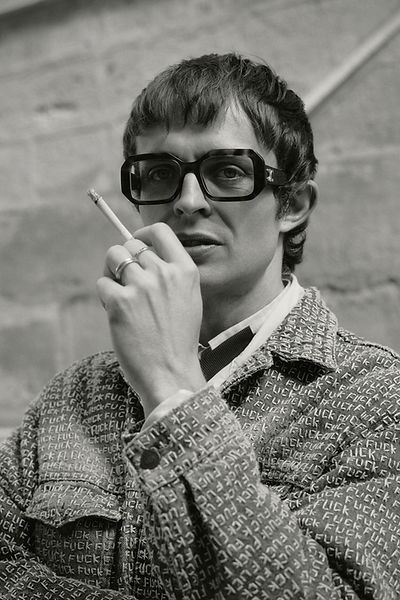

Thomas Liu Le Lann, portrait. PH: Kostromin Alexey.
© Courtesy of FVTVRIST.
About Thomas Liu Le Lann
Thomas Liu Le Lann (b. 1994, Geneva) works across sculpture, installation, video, and writing to examine vulnerability, desire, and the politics of the body. His practice is built from autofiction and intimate encounter, populated by Soft Heroes: faceless textile figures that refuse the upright vocabulary of heroic form. Recent projects include Entertain at E-WERK Freiburg, Sky Rush at Xippas Geneva, and a public commission at BY ART MATTERS, the Renzo Piano museum in Hangzhou. His work is held in the Sammlung Jakob, and he was included in Anti Heroes, the Jakob Collection exhibition at Villa Merkel, Esslingen am Neckar.
A finalist for the Swiss Art Awards 2026, he writes the editorial texts for Kissed then Burned, an independent space in Geneva. He is currently presenting Training Part IX in Spielfeld. Sport & Kunst at the Museum für Neue Kunst, Freiburg, and will take part in Basel Social Club during Art Basel week, June 2026. Represented by Xippas Gallery, Paris and Geneva.


_2025_102%20x%2091%20cm_1.jpg)