© Photo Miguel Mendez
Notes from SWAB 2026
observed by Ana Marinkovic
For FVTVRIST Magazine // October, 2026
October is the annual peak of art market oversaturation, a month where the global calendar turns into a frantic circuit of corporate mega-fairs. After navigating the blue-chip machinery whose primary function is asset-class investments, VIP lounges that resemble airport lounges and champagne bars, a collective exhaustion is definitely present. The crisis of contemporary conglomerate air fairs is multilayered but underneath those layers is just an engineered machinery made to optimize transactional speed while flattening the actual experience of looking at art.
At the height of fair season, when curators, gallerists and artists are burnt out, SWAB provides a refreshing counter-infrastructure to this usual chaos. Bringing together over 60 emerging galleries, independent spaces and curated special initiatives, the fair’s 19th edition resists the corporate spectacle. At the Palau Victòria Eugènia on Montjuïc, SWAB’s new location, gallerists, artists and viewers engage in genuine dialogue and unpretentious exchange rather than performative market posturing. This ethos is deeply connected to Barcelona’s broader art scene. Unlike the hyper- art scenes in huge metropolitan cities with competitive markets, Barcelona is nurturing the culture of decentralized networks, self- organized artist initiatives, oriented towards acceptance, community, autonomy and subversion. In this sense, SWAB reflects this ecosystem rather than appropriating the global one. The most potent art still happens away from the big fairs, where there is an opportunity to discover emerging talent.
Here are five highlights of this year’s edition.
Mina Fouladi / outhouse (London)
Presented by outhouse, independent artist-run space from London, British-Iranian artist Mina Fouladi presents the artworks that are the exact ethos of unpretentious, valuable discovery that makes SWAB so different. In a time of geopolitical turmoil, war crimes and forced displacements, home becomes accessible only though fragile and fading memory. Her work evokes an aching nostalgia and the feeling of letting go. Foulad’s process is grounded in the rupture between physical and urban residue. She paints directly onto street surfaces before peeling and transferring these painted skins onto small concrete bricks. By binding the visuals to literal fragments of urban infrastructure, the works carry the physical layered histories of the street and at the same time, represent an archival process of preserving memory. Viewed through horizontal window shades, she paints intimate interiors that remain partially obscured. Standing in front the painting feels like peering into a room you can no longer enter, which acts as a metaphor for memories that are structurally inaccessible.


LAN Chung-Hsuan / Wei Ming Ming (Taipei)
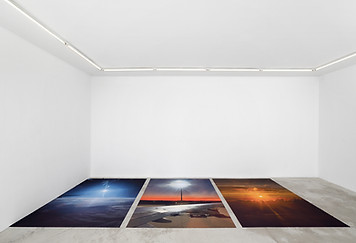
Continuing down nostalgia lane, Taipei-based platform Wei Ming Ming (which means ‘Untitled’) presents LAN Chung-Hsuan’s image-based practice. LAN is engaging with distressing conditions such as war, disaster, historical events in his exploration of civilization and relational structures between image, power and technological systems. Instead of documenting grand political narratives, LAN turns toward what politics erases by showing how individual lives and family photographs become delicate footnotes in a landscape dominated by conflict. In the booth, among other artists Wei Ming Ming represents, LAN presented two digital collage photographs: Missile Crisis (2023) that presents a nostalgic photograph of a father holding a young child, disrupted by a missile silhouette inserted into the sky above and Clear-air Turbulence (2024) that shows a commercial plane wing above the clouds with the erratic intrusion of a missile launch plume. Through these low-fi digital photo collages the artist shows the contemporary condition of Taiwan, where the threat of conflict seems to be normalized. His works expose the precarious ways human memory persists in a landscape of political friction.
Schoko Tanaka / MATTER (Tokyo)
Transitioning from digital-analog archives, we encounter warm and visceral mythologies of Schoko Tanaka, presented by nomadic artist-run collective MATTER. This collective is moving between Tokyo and London carrying an anti- institutional narrative. Within this fluid narrative, Tanaka’s practice brings an intimate animalistic symbolism to this booth. She works with the motif of a horse, that she approaches with cartoonish softness and graciousness that feels both feminine and deeply nostalgic. In her main painting, a pale horse is nested beneath a plant with flowers and beneath his hoof is a broken arrow representing quiet strength. The surface of the painting is materially dense as Tanaka embeds textured embroidery and textile work directly into the canvas. Adjacent to this piece, smaller paintings of red and brown horses are framed with swirling iron frames, the ones, as she says, remind her of Spanish house fences and balconies. Her hybrid paintings are acting as gentle, feminine and tactile sanctuaries, transforming the space into a poetic site of memory, encounter and warmth.


Marga Estelrich/ 200CENT with Fundació Úniques (Barcelona)
Extending the thread of soft, feminine forms explored in Schoko Tanaka’s works, the joint booth presented by 200CENT and Fundació Úniques translates this ethos of care into a collaborative feminist framework. Founded by Anna Floto and Natalia Foguet, this hybrid initiative bridges an artist-run space with a non-profit foundation dedicated to emerging women artists across Catalonia. Rather than looking at fair booths as competitive commercial spaces, their shared booth operates on collective resource-sharing and institutional care. Works that caught my attention were by Marga Estelrich. Her practice engages with material landscape and its distribution, as well as mechanics of public space. Stuck in between industrial stainless-steel handrails, resembling transit grab-bars, her mounted photographs capture everyday urban scenes. They show dense, kinetic clusters of street pigeons feeding on pavement grain or vacant park benches. By isolating these fragments of contemporary urban life and reframing them, we get the feeling of odd familiarity and displacement. Esterlich’s work subtly alters our perception of overlooked street phenomena into a look on how we inhabit these public spaces together.
Vortex Project
This local praxis of institutional solidarity is exceptionally highlighted with the Vortex Project. Curated by Lena Solà Nogué, Catalan curator based in Mexico, this project fundamentally dismantles the traditional competitive structure of art fairs. It evolved from last years “Emerging Latam” program, but this year the initiative has been expanded to include Central America and smaller regional hubs, rather than just Latin American capitals with established cultural influence. Vortex follows a model of shared space, with 12 independent galleries paired up to co-inhabit the same space. As Lana Solà passionately explained, sharing space is a matter of practical survival. Splitting booth costs makes the fair accessible to younger galleries, but the real benefit is cultural. Sharing turns isolated sales floors into active hubs where galleries swap resources, plan residencies, and build lasting networks. Collaborations like Havana’s Ona Galería with Barcelona’s Herrera Gallery prove that the fair can act as an incubator for long-term transnational infrastructure. Conceptually speaking, the work shown exhamines how we think about territory, memory and the body. Participating artists are using food, ritual and gossip as relational concepts to challenge mechanics of the market.
Ultimately, Vortex Project is a perfect example of what SWAB 2026 represents. In global art market suffocated with hyper-financialized market spectacles and the sterile monotony of the blue-chip galleries, SWAB shows that there is still space for intimacy, collective exchange and care. By prioritizing independent voices, young artists, collectives, galleries and shared resources over conglomerate commerce, it’s a reminder that art fair can actually be a place of genuine encounter.

Courtesy of Irma Marco/ Herrera Gallery (Barcelona)
About Ana Marinković
Ana Marinković (b. 1997) is a transdisciplinary artist, researcher and writer based in Barcelona, Spain. She holds a BFA and MA in Sculpture from the University of Arts Belgrade and is a PhD candidate in Transdisciplinary Studies of Art & Media Theory at the Faculty of Media and Communications. Working across video, sound, spatial installation, and critical theory, her practice operates at the intersections of contemporary art, science, technology, and feminist theory. Her research examines transitional states and liminality, non-linear cartographies, knowledge production via mapping, synthetic cognition, algorithmic structures, and biological sensing. Collaborating directly with scientists, she translates experimental scientific research into artistic form, while her doctoral dissertation develops a critical cartography of contemporary art grounded in rhizomatics and situated knowledge.
She works as independent writer and art critic since 2024.