
WOULD YOU WEAR MY EYES?
In dialogue with Nicolas Lebeau
FVTVRIST Magazine // Interview by Elina P.
22 March 2026
I can’t go out anymore.
I shall sit on my ceiling.
Would you wear my eyes?
— Bob Kaufman
If the city was a living organism, its streets would be veins, its windows shallow eyes. Surveillance cameras and deterrent devices ~ scar tissue. Nicolas Lebeau takes these elements, usually masked, out of their context to make them visible. His images arrive blurred, sourced from places kept out of sight, then re-inscribed into the neutrality of the exhibition space.
The first solo show of French-Brazilian artist takes place at Mennour within this same tension: electrical, contained, never fully discharged.
In dialogue with FVTVRIST, he returns to the origins of this body of work.

Exhibition View © Archive Mennour
FVTVRIST: Your exhibition Would You Wear My Eyes? begins with elements taken directly from the city: anti-climb spikes, surveillance cameras, deterrent devices. When did you start seeing these objects not just as infrastructure, but as a visual language?
Nicolas Lebeau: This interest in hostile systems you find in the street comes from the fact that I grew up skateboarding. Way before I started thinking about art or image-making, I had already understood that you could transform things, that you could reappropriate and reclaim structures that were designed to suppress you or keep you in a kind of alienation. Simply speaking, I didn’t feel like I have to be a passive user of the city.
Photography came later. For someone who hasn’t been trained in drawing or exposed to painting or sculpture, the most immediate tool you have is a camera. Looking back, I realize it was never really about preserving memories. What fascinated me was the palpability of it: handling the camera, climbing walls to find the right angle, developing film, touching the chemicals, the smells. It was very physical, almost bodily, that’s what really drew me in.
By the time I entered art school, I already had a strong interest in writers, filmmakers, musicians, often more connected to alternative culture, or so-called marginal figures. For example, someone like Šarūnas Bartas or Boyd Rice, you don’t hear about them much in art schools. Or poets like Bob Kaufman, who gave the title to my exhibition. Art school felt more conventional in comparison.
It was out of a kind of fatigue linked to the consumption of an ever-growing quantity of images, did I begin to lose interest in photography. It was at that moment that I started trying to produce a different kind of images, and above all to think of my work as an ecosystem, where images enter into dialogue with architectural elements taken from the street. Once transformed into sculptural matter, I can domesticate them and make them say something other than what they were designed for.
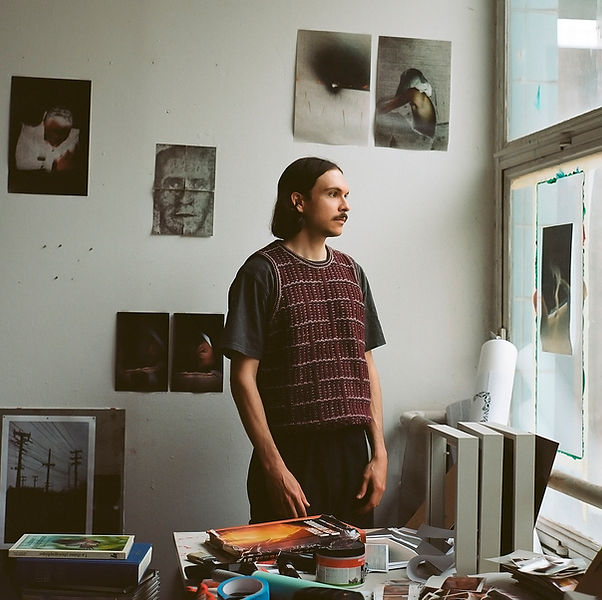.jpg)
Nicolas Lebeau ©Courtesy of Nicola Lo Calzo
That’s where you started to “dissociate” your images?
I started experimenting with processes: transferring images onto steel, degrading them. And it was when I began placing these images in space that I realized the exhibition space itself was just as important as the images.
For me, an exhibition space became like a skate spot. The wall matters as much as what’s on the wall. The architecture, the shapes, a column here, a sink there, everything becomes part of the work. My installations started taking on sculptural forms. It was only at the time of my diploma that I allowed myself to go further into building architectures.
For example, one of the first sculptural pieces I made was based on a form I had known since childhood: broken glass embedded in walls, something very common in Latin America cities, especially in Rio. It’s an improvised anti-intrusion system: people place shards of glass on top of walls with mortar so no one can climb over. I reinterpreted it using flat glass, onto which I placed faces of people wanted by the police in the state of Rio, taken from a large mugshot database. I wanted to reverse that role, to turn them into guardians of the space.
Later, I also started melting glass bottles. What I like about them is that an empty bottle can immediately suggest a weapon: a broken bottle, a Molotov cocktail, but once melted, it becomes soft, less aggressive. Almost awkward. They also echo the way I photograph bodies, often in states of apathy or suspension.

Exhibition View © Archive Mennour
.jpg)
Exhibition View © Archive Mennour
Some of your images come from photographs you take yourself, while others come from images already circulating online, particularly those of bodies. How do you source them, and what are your thoughts about the ethics of using existing images?
Regarding the images I collect, many come from Telegram. Ethical questions come up often, especially from people with direct connections to conflict zones. I’m very careful never to reveal identities. The images are always fragmented, pixelated, you don’t see everything immediately.
Today, these images are everywhere. Ten years ago, artists would retrieve hidden images from the depths of the internet. Now they’re already circulating constantly, embedded in our visual environment. There’s no point in showing them directly.
What interests me is making them appear almost like a flicker, something you sense, almost. From a distance, the compositions can seem somewhat ornamental, even harmonious. But when you come closer, you start recognizing fragments, a foot, a body, understanding what’s really there. I’m interested in confronting our generation with this condition: we don’t experience events directly, but through images. These images contaminate ours and I hope my images act back on them.

Exhibition View © Archive Mennour
Your work often touches on questions of power, monitoring, and control in contemporary cities. Do you see the role of the artist here as exposing these systems, or rather inventing other ways of looking?
I’ve always been wary of politics and activism, in the sense that I’ve never engaged in a frontal political way. For me, trying to change your destiny is already political. In my case, that takes the form of wanting to be an artist, but it could take many other forms.
So yes, you ask me whether I see the role of the artist as someone who should reveal things or invent new ways of seeing. I think we shouldn’t try to look differently, we have to see things as they are. They might be terrible, tragic, but I think we still have some hold over them.
There was also something I understood when I stayed in Brazil for an extended period of time in 2023: what interested me were the kinds of resistance I called intimate resistance, that can pass through small gestures.
Handling the camera, climbing walls to find the right angle, developing film, touching the chemicals, the smells. It was very physical, almost bodily, that’s what really drew me in.


Exhibition View © Archive Mennour
Exhibition View © Archive Mennour
Speaking of Brazil, there is always this question, when you grow up between countries, the one of belonging and self-definition. How was it for you?
For a long time, I was mostly confused about it. For me, I was neither truly French nor Brazilian, I was just a bit of both. I made a very clear distinction between what I was doing in France and what I was doing in Brazil. And I could feel there was this strong desire to reconcile those two parts of my identity. Last time I was there, that was the most important thing I understood: that in fact I was neither French nor Brazilian.
At first, I thought I was nothing.
But in fact, from nothing, you can make everything. I find myself more and more in that space, between two cultures, two identities, as a complete stranger to both.
An alien.
Yes. And I think it’s relevant, because more and more of us are in these kinds of situations. More and more aliens. What once felt obscure or unsettled, becomes a form of freedom. A space where something can be invented.
The exhibition also includes a sound work created with musician Paola Avilés. How did this collaboration come about, and what interested you about bringing that kind of sonic control into the exhibition?
There is really this desire to occupy spaces, to inhabit spaces. At first you do it physically, with images, with sculptures. And for this exhibition, I told myself I would go all the way and do it with sound as well. It’s a kind of non-space.
I was thinking about mosquito devices - those very small speakers that emit a very sharp sound. They say only young people or pigeons can hear it. They’re often used to keep teenagers from gathering in certain areas without using visible force. And often these speakers are placed inside cages, because once you notice them, all you want to do is destroy them. So that’s what we did for the show.
There was really this idea of occupying the gallery, of creating a situation where the viewer has no respite, whether physically, visually, or aurally. I gave Paola complete freedom over the composition, I would only give her my intuitions. She turned them into sound.
And in the end, there are fragments of the poem that gives the exhibition its title, Would You Wear My Eyes? by Bob Kaufman, because we found a recording of him reading it, it’s magnificent. There are fragments of that. There are fragments of prayers I recorded while I was in Brazil. There are sounds from my studio, sounds of Paola laughing, sounds of Paola singing when she was a child.
Finally, what are you working on now? Are there upcoming projects or directions you can share?
In more concrete terms, in September, I have an exhibition on the theme of post-photography, as part of the bicentenary of the invention of photography. It is curated by Emmanuelle Halkin, with five other photographers at Le Quadrilatère in Beauvais.
In November, I have a show at Le 6B in Saint-Denis with two young curators, Nathan Magdelain and Léa Jallut.
Lately, I’ve been working with undocumented Brazilian workers on construction sites here in France, and with a religious community in Brazil guided by a childhood friend. I’ve made a few images so far, but mostly I’m trying to live with them and understand what I’m looking for there.
Those interest me a lot. For me, the human experience comes before the aesthetic or intellectual one. What will remain of all this in 50, 100, or 1000 years?
Probably not much, except the feeling that we have fully lived, loved, invented, discovered what life had to offer, while everything is designed to conceal it behind a bright surface of illusions.
About Nicolas Lebeau
Nicolas Lebeau is a French-Brazilian artist. His work unfolds through systems of circulating information and continuous echoes — between here and elsewhere, present and past, virtuality and materiality. While engaging in both the production and collection of images, he seeks to subvert modes of representation that perpetuate certain forms of predation upon individuals.
Over time, he has developed a range of strategies that deviate from the photographic medium, allowing him to explore themes such as displacement, the loss of meaning in the contemporary world, and the excesses of technology. By creating ensembles that occupy space, he aims to restore a sense of physicality to the photographic experience.
A graduate of the École Nationale Supérieure d’Arts de Paris-Cergy, his work has been regularly presented in publications and in both solo and group exhibitions, notably at Galerie Mennour, the Ygrec art center, the Fondation Francès, the Institut français d’Espagne, and La Grande Halle de La Villette.


