
Half-Forgotten, Misremembered
In dialogue with K.T. Kobel
FVTVRIST Magazine // Text and Interview by Elina P.
7 July 2026


K.T. Kobel, Studio shots, Credit: Shot by Anique Bosh @shotbyjustme
Born in 1988 in the UK, Kobel now lives and works in Amsterdam. His practice centres on painting, but it extends outward into publishing, photography, and film through IMAGE CRISIS, a parallel project that began as its own kind of breakdown. IMAGE CRISIS gave him permission to think differently: to collect, write, collaborate, publish, and follow an idea without worrying whether it would ever end up on a canvas.
The paintings themselves occupy a very specific register. The process is built on delay and accumulation. Transfers, chemically broken-down pigments, layers of encaustic, glazing, more traditional brushwork: each stage pushes the original source a little further from where it began. If a painting can be understood in the first few seconds, he usually feels it has given too much away.
What holds the practice together is a particular way of looking, developed over years inside the kinds of images most people scroll past: eBay listings, Flickr archives, neglected corners of the internet, screenshots from exploitation films paused at the moments either side of the event. Empty rooms. Furniture. Curtains. The strange details sitting quietly in the background. Kobel has folders full of images, both digital and physical, that he has carried around for years. In many cases he could not tell you where they came from anymore, or even why he saved them. He likes that. It means the image has outlived its original purpose and started another life. That is often where a painting begins.
Fvtvrist spoke with K.T. Kobel about borrowed images, repetition compulsion, and what a painting can hold that the moving image was designed to carry past you.
Your work has a very specific cinematic atmosphere. There's something almost old-school about it, closer to the dread of Andrzej Żuławski's Possession or early Cronenberg than to anything contemporary. Is there a film, a director, a visual universe that sits closest to what you're building?
There are films I return to constantly, but I don't think I'm trying to build a cinematic world so much as a psychological one.
Cinema has been part of my life for as long as I can remember. I was an only child to a single mum who worked two or three jobs, so I spent a lot of time on my own watching whatever she'd left on before going to work. Later it became Blockbuster, LimeWire, private trackers and a fairly unhealthy obsession with finding whatever films everyone insisted were the most disturbing.
As I grew older Haneke was probably the biggest turning point. I remember watching The Seventh Continent and realising that somewhere along the way I'd stopped waiting for the story and had started watching the objects instead. A toothbrush. A carton of milk. A pair of shoes. He gives those things the same weight as the people. Nothing announces itself as important, which means that later, when those objects begin disappearing or being destroyed, the violence feels inevitable rather than dramatic. I don't think I'd ever seen a film pay that much attention to ordinary things before. It completely changed the way I looked at images, and probably the way I paint them too.
From there the references become much harder to separate. Lynch, Cronenberg, Argento and Żuławski are all in there somewhere, but so are photographers, pulp paperbacks, eBay listings, old television, vintage fetish magazines, neglected corners of the internet and things I've probably half-forgotten or misremembered. By the time they reach the studio they're all feeding the same place.
Most of the paintings begin with very ordinary images. A hand on a car door. Someone standing beside a curtain. A face caught in an awkward expression. Things that people would probably overlook.
I've never really wanted to paint the event itself. What stays with me are the moments around it. The hesitation before something happens, the silence afterwards

The Seventh Continent, Michael Haneke, Credit: IMDb


You describe isolating fragments of memory and stripping them of their original context. What happens to a memory when you remove the story around it? Does it remain truthful to the events?
I don't think memory is particularly reliable to begin with. When I think back to certain moments, I almost never remember a complete sequence of events. I remember an image, a marker of that moment. Somebody standing in a doorway. A particular expression. The way a room looked late in the afternoon. A cigarette burning in an ashtray. Even then, the memory is already selective. Certain details remain while everything else quietly falls away.
When we talk about memory, and by extension images, I don't think I'm really removing the story. Most of the time it's already disappeared. I'm choosing an image and allowing it to carry a different emotional weight, or placing it alongside another image to create a different sequence, a different way of reading what happened.
I think once you separate an image from its original context, you inevitably begin projecting yourself back into it. Your current emotions, your experiences, your biases all start reshaping the way you read it. In that sense, the image doesn't become empty. It becomes available.
K.T. Kobel.
Courtesy of Kutlesa Gallery @kutlesagallery


Misc photos, Credit: Courtesy of the artist
The airbrush produces a surface that is technically smooth, almost frictionless. But the content: trauma, power, the body under pressure, is anything but. Is that tension between surface and subject deliberate or did it find you?
A bit of both.
The airbrush was really just the beginning. What attracted me was the different ways it allowed you to render an image. You could move between something incredibly precise and something much more elusive almost immediately. I liked how quickly things could become uncertain.
That gradually led me to develop the rest of the process. Transfers, chemically breaking down the pigments, airbrushing into them, layers of encaustic, glazing and more traditional brushwork. Each stage pushes the original source a little further away from where it began.
What interests me now is delaying the readability of the image. I don't want everything to be available immediately. If a painting can be understood in the first few seconds, I usually feel it's given too much away. I'd rather the viewer spend time with it, gradually noticing things they missed the first time around.
Music videos have produced some of the most charged visual language around trauma, desire, and power, often working in exactly the register your paintings occupy. Has that form influenced how you think about the image?
I think so, although probably not consciously.
What I admire about the form is how easily it can operate without narrative constraint. You can build meaning through colour, gesture and association. That's something I've become increasingly interested in across all forms of image-making.
Once you remove the story, the image stops illustrating an event and starts behaving more independently. It becomes less descriptive and, hopefully, more open. Different people bring different memories to it, which is something I really like. I don't want the painting to close down around a single interpretation.
IMAGE CRISIS operates as a parallel project to your studio practice. What does it add to your practice? What is the crisis in the title referring to specifically?
In all honesty, IMAGE CRISIS probably began as my own crisis. For a long time I equated making work with making paintings, and there were periods where I simply didn't want to paint. That felt like a problem because painting had become so tied to my identity and later on my career.
IMAGE CRISIS gave me permission to think differently. To write, publish, collect, make books, collaborate with people or simply follow an idea without worrying whether it would ever end up on a stretched piece of linen.
One of the first things I made was a book of over a thousand screenshots taken from exploitation films. People assume it's full of nudity, but there isn't any. I found myself pausing the films for the moments either side of the event. Empty rooms. Furniture. Curtains. The strange details sitting quietly in the background. Looking back, I think I was already looking at films in exactly the same way I now make paintings.
I don't really see IMAGE CRISIS as separate from the studio anymore. They feed into one another. Some ideas eventually become paintings. Others become books, photographs, films or pieces of writing. It's become a much more balanced practice because no single medium has to carry everything on its own.
I'VE NEVER REALLY WANTED TO PAINT
THE EVENT ITSELF. WHAT STAYS
WITHME ARE THE MOMENTS AROUND IT.
THE HESITATION BEFORE
SOMETHING HAPPENS,
THE SILENCE AFTERWARDS.


K.T. Kobel.
Courtesy of Kutlesa Gallery @kutlesagallery
Witness Without Language is a very loaded title. Who is the witness in that piece, and what are they witnessing?
The title is about the position of the viewer. I think that's true of most of the work, really. The paintings tend to place the viewer in a slightly uncomfortable position. You're looking at something private, or at least something that feels private, but you're never given enough information to be certain of what you're seeing.
I've always been interested in that experience. Looking through a window for a second too long. Watching someone on a train. Catching the end of a conversation and instinctively inventing the beginning. We do it all the time. Faced with incomplete information, we can't help constructing a story.
In Witness Without Language that becomes more explicit. A peephole. A blurred face. A body in water. A gesture that could be intimacy or submission. None of those images settle into a single meaning.
So the witness isn't really a figure inside the painting. It's the person standing in front of it. The painting isn't asking you to solve it. It's asking you to notice the story you've already started telling yourself.
(Beyond) The Pleasure Principle references Freud directly, the idea that something in us drives toward destruction, repetition, beyond what pleasure can explain. Where does that sit in your work?
I think it's less about destruction than repetition.
Most people recognise repetition in their own lives. We return to the same relationships, the same situations, the same behaviours, even when we already know where they'll lead. Freud's observation wasn't simply that we repeat ourselves, but that we often seem compelled to recreate experiences that have already wounded us.
I don't know whether making work functions in exactly the same way, but I recognise something familiar in it. Over a long enough period you realise you've been returning to the same images, the same emotional situations, the same questions without ever consciously deciding to. I rarely notice it while I'm making the work. Recognition usually comes years later.
I don't think painting resolves those things. If anything, it keeps returning to them. But perhaps that's part of why I continue making it. Not to explain those experiences, but to keep looking at them from different angles.
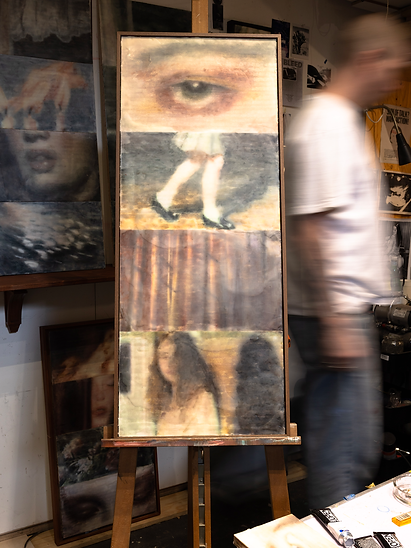
K.T. Kobel, Studio shots
Credit: Shot by Anique Bosh
@shotbyjustme
What are you building toward right now? Is there a larger world that these individual pieces are fragments of?
Not a larger world per se, but certainly the same life. In retrospect I can see that the paintings, books, photographs and films all seem to be asking the same questions. They don't necessarily share characters or narratives, but they seem to belong to the same way of looking. That's usually something I recognise afterwards rather than while I'm making the work.
I'm working on a couple of short films at the moment, alongside the paintings. For a long time film existed mostly as a way of thinking about images or collecting references, but I've started taking it much more seriously as a medium in its own right. I'm interested in seeing what happens when those same concerns unfold through time instead of existing in a single frame.
Painting is still central to what I do and I can't imagine that changing. The rest still feels pretty open, which is probably exactly how it should be.


K.T. Kobel, "Hand, Body, Object, Sin", solo exhibition at Kutlesa Gallery
Courtesy of Kutlesa Gallery @kutlesagallery
About K.T. Kobel
K. T. Kobel (b. 1988, UK) is a British artist based in Amsterdam. Working primarily in painting, his practice also encompasses photography, writing and moving image. Drawing from cinema, found photography and vernacular imagery, Kobel reworks disparate source material into paintings that unfold through recurring motifs and sequences. Figures appear as fragmented, anonymous presences suspended between intimacy and distance. Rather than illustrating direct narratives, Kobel constructs psychologically charged images that invite viewers to inhabit the uncertainty between what is remembered, imagined and observed.


_edited.jpg)


