
-
Inside the Headspace of HazzA
Inside the Headspace of HazzA
In dialogue with HARRY LYNCH
FVTVRIST Magazine // Text by Elina P.
28 May 2026
Harry Lynch paints under the name HazzA, a persona that grew out of an Australian childhood nickname and a 2016 playlist built to summon a particular headspace. That headspace hardened into an alter ego, a caricature shaped by stubbornness, ego, sadness, madness, jealousy and anger. HazzA acts as a translator, carrying signals from the subconscious into paint.
The results read as fragments. Roads, toy guns, mirrors, cars and flowerpots surface from daily life, lifted out of their usual context until they turn strange. Humour runs through all of it, sharp and often dark, a way of handling weight. Lynch treats the work as a journal and wants viewers to find their own way in. If a painting leaves people asking what he meant, he counts it as a failure.
In dialogue with FVTVRIST, HazzA talks origins, the persona living in his subconscious, his suspicion of contemporary image culture, and the new body of work he is keeping quiet for now.

Harry Lynch.
PH: Hans Borg. © Courtesy of the artist.

Harry Lynch. Portrait. PH: Hans Borg. © Courtesy of the artist.
First things first, where does the name HazzA come from?
The name Hazza comes from my Australian background. Growing up, friends and family would call me that and it just stuck. In 2016, I created a playlist called Hazza’s MAD with my best friend. It was made up of music that put me in a certain headspace, whether that was focused, driven, or frustrated. It became something I used to get into that mindset. Over time, that feeling and expression evolved into the alter ego I have today, one that carries a mix of emotions, from being sharp and in control to more tense and reactive.
Is HazzA someone separate from you, or just a version of yourself pushed further?
HazzA is a persona that exists within my subconscious, acting as a translator between my subconscious and conscious mind. It represents a caricature of myself, an exaggerated version shaped by emotions such as stubbornness, ego, sadness, madness, jealousy, and anger. I channel these feelings into this distorted, symbolic reflection of who I am.


HazzA.
1/ Survival of the fittest
2/ Raygun
3/ Space Invader
4/ Shit Show
© Courtesy of the artist.
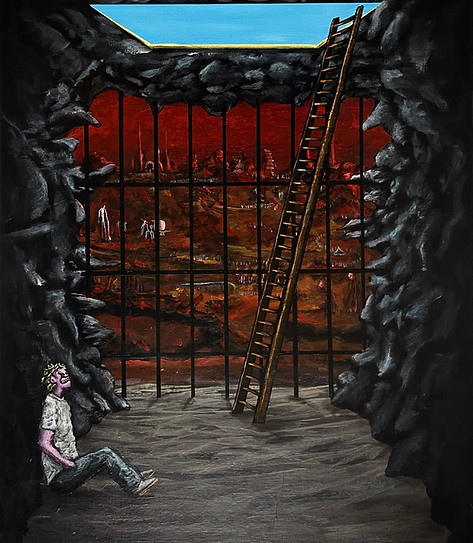
Your paintings feel like fragments of a story rather than full scenes. Do you think about narrative when you work?
During the process of creating a painting, the concept does not always come from my conscious mind. It is more of a merge between my subconscious and me. I act as a vessel for ideas that are fed to me by something I do not want to question.
In most paintings, the concept is heavily loaded with metaphors from my daily life, thoughts, feelings and so on. It all translates into a visual language.
There’s a strong sense of humor in your work, but it can turn quite sharp or dark. Is that something you aim for?
Yes, that is exactly the goal within my paintings. I use humor as a way to deal with and talk about heavy topics that I struggle with. I feel like humor is the best medicine for a world with such deep rooted conflicts and evil.
HazzA. Dystopia.
Dyptique, Acryl & Charcoal on Canvas.
60x80 cm.
© Courtesy of the artist.

PH: Hans Borg. © Courtesy of the artist.
What is essential to know to better understand your work?
My work is meant as a journal for my own thoughts, feelings and battles. Also, I believe that what is most important is that people look at my work and see where they can relate, rather than questioning what I meant. What it means to them is more important than what I tried to say. If the work raises too many questions about my intention, then I failed.
Your work seems to play with and push against contemporary image culture. Is that a conscious reaction?
Yes, this is something I try to focus on. I grew up during this new age of social media and online culture, so it naturally becomes integrated into my work. But I also want to push against it because I think contemporary culture is wack as f*ck at the same time. So there are moments where that clash becomes visible in my work.
What are your main references right now: artists, films, everyday things?
My main references come from everyday objects that seem mundane in daily life, but become more interesting when removed from their usual context, such as roads, toy guns, mirrors, cars, and flowerpots.

HAZZA IS A PERSONA THAT EXISTS WITHIN MY SUBCONSCIOUS, ACTING AS A TRANSLATOR BETWEEN MY SUBCONSCIOUS AND CONSCIOUS MIND.
I CHANNEL THESE FEELINGS INTO THIS DISTORTED, SYMBOLIC REFLECTION OF WHO I AM.
What are you working on at the moment? Do you have any upcoming projects or shows we should know about?
At the moment, I am working on a completely new body of work that dives deeper into my surroundings and questions everyday life.
As for projects, I will keep it on the low. Just keep an eye out and you will see for yourself.


HazzA.
1/ Nine to Five
2/ Exodus
3/ Mental Revolution
4/ Paradoxical Respawn
5/Imaginary Conversations
© Courtesy of the artist.
About Harry Lynch
Harry Lynch, working under the name HazzA, is a Belgian contemporary artist whose practice unfolds through painting, drawing, and sculptural experimentation. Born in 2000 in Knokke and currently based in Bruges, Lynch constructs psychologically unstable image-worlds where subconscious impulses, emotional residue, and contemporary visual culture collide.
At the core of the practice exists HazzA, not simply as a pseudonym, but as a mediated psychological entity operating between the conscious and subconscious mind. Through this alter ego, Lynch develops a visual language built from fragmentation, distortion, symbolic displacement, and dark humor. Everyday objects recur throughout the work, roads, mirrors, toy weapons, cars, flowerpots, domestic fragments, detached from their functional reality and repositioned as emotionally charged archetypes.
Rather than constructing linear narratives, Lynch approaches painting as a form of psychic excavation. His compositions behave like suspended mental landscapes where tension, ego, melancholy, absurdity, jealousy, and aggression coexist simultaneously. Humor becomes both protective mechanism and critical device, allowing emotional weight to surface through irony and visual instability.
Positioned within a generation shaped by hyper-visibility and digital saturation, Lynch’s work reflects an ongoing friction with contemporary image culture itself. The paintings oscillate between attraction and resistance, intimacy and caricature, creating spaces where personal mythology and collective visual language begin to collapse into one another.
Through exaggerated figuration, unstable spatial logic, and psychologically loaded symbolism, HazzA constructs paintings that resist fixed interpretation, instead inviting viewers into an encounter with their own subconscious projections.


_edited.jpg)


