
collant, poisseux, visqueux
In dialogue with Clara Lou Villechaise and Rémi Galtier
Inaugural Exhibition at Galerie Nicolas Salloum
FVTVRIST Magazine // Text by Elina P.
4 May 2026
From 19 March to 14 May 2026, Galerie Nicolas Salloum inaugurates its first exhibition : collant, poisseux, visqueux.
The title alone is almost uncomfortable to say out loud. It sticks to the mouth. It is not the language of galleries and white walls. It arrived not through deliberation but through resonance, instinctively, the way the best titles do, a word that held equally against the tar-like fluids invading Clara Lou Villechaise's canvases and the ceramic volumes Rémi Galtier builds, obstructs, and quietly pierces. Something they had both been circling without quite having named. The two artists work separately, in different studios, showing each other very little during the making. And yet when the works entered the same room, something clicked into place almost immediately, a dialogue so natural it was, by their own admission, moving. Fvtvrist met the two artists to talk about sticky matter, unstable forms, and what happens when two practices collide in the same room.

Photo : Charlotte Grébert
© Courtesy of the artists and Galerie Nicolas Salloum

Exhibition view
Photo : Charlotte Grébert
© Courtesy of Galerie Nicolas Salloum
The title collant, poisseux, visqueux (sticky, gooey, viscous) is almost uncomfortable to say out loud, which feels very deliberate. Where did it come from?
The title came quite instinctively and perhaps that says something in itself. We worked very little side by side, deliberately avoiding too much exchange in order to preserve what remains personal to each of us within a shared act of presentation. Separate studios, very few things shown to one another. It was really through discussing our intentions, the theoretical dimension of our works, what was driving us, and the research nourishing our visual forms, that the title eventually emerged.
I told Rémi about a text by Timothy Morton — the conceptual foundation of the painting series I'm currently showing — which speaks of a real ecology that would be ugly and slimy. The word "slimy" resonated with Rémi, and he started looking for synonyms. That is when he found sticky, gooey, viscous. It worked just as well with the tar-like fluids that invade the paintings as with the materiality of the sculptures — and in that way, the title brought us together around a shared intention we hadn't quite articulated yet.


1/ Clara Lou Villechaise, Mazout 4, 2025, oil on wood
2/ Rémi Galtier, Gardien perché, 2026, glazed stoneware, gold
3/ Clara Lou Villechaise, Résidus 4, 2026, oil on wood
© Courtesy of the artist of Galerie Nicolas Salloum

This is the very first show of Galerie Nicolas Salloum, a gallery that from the start has positioned itself around instability, transitional spaces and hybrid forms. Did that framework shape what you brought in?
Nicolas trusted us completely and gave us a great deal of freedom in our choices and actions. We selected the works together, of course, but he allowed us to express ourselves fully in the installation. We wouldn't say it influenced the actual visual form of our pieces or what we produced, we simply felt very free, and we believe that is something extremely valuable when working with a gallerist.
So to answer directly: the gallery's curatorial framework did not shape the work itself. In any case, it never hindered, restricted, or constrained anything.
Rémi Galtier
Zelda pingpong excavation, 2026
Stoneware, engobe, electric wire, sockets, switch
© Courtesy of the artist of Galerie Nicolas Salloum

Rémi Galtier
Cul en l'air, 2026
Glazed stoneware
© Courtesy of the artist of Galerie Nicolas Salloum
Clara, talking about your landscapes, is there still something you want to hold onto from the tradition of landscape painting, or is the gesture more of a dismantling?
Very certainly both. I clearly draw on clichés and conventions from art history, particularly those of 17th- and 18th-century pastoral painting — scenes that depict an idealized harmony between humankind and nature, serene and rural, with a highly poetic vision. I wrote my graduate thesis on moonlight in painting, and beyond the strictly pictorial questions around the instability of color in relation to light, my research led me deep into Romantic landscapes. That body of work has left many traces in what I paint today.
The series currently on show brings together a telescoping of spaces and times. The landscapes I imagine are laid out like frescoes on geometric volumes, isolated within a kind of non-space bathed in artificial light that recalls screens. Into these imagined landscapes come the sticky, viscous fluids that evoke oil and it is precisely those elements that begin to endanger and fracture them.
Rémi, your objects start as recognizable things: vases, containers, speakers and somewhere along the way they stop being that. At what point does an object lose its identity for you, and what takes its place?
In some of my sculptures there is a sense of things being unsettled, a kind of quiet chaos at work, the vision of an object that has been broken, stripped of its original function, yet whose image persists almost like a ghost. At that stage it still carries its full identity, a strong shared reference, because these are often very familiar, everyday things.
From there it becomes a space where function dissolves and form emerges as a kind of survival, an apparition without a clear purpose. The archetype of the jug, as a generic and vernacular form, is tied to the long history of ceramic. It brings to mind an ancient Egyptian tradition in which utilitarian objects were transformed upon a person's death and buried with them, to ensure a successful resurrection. In this case, these objects are pierced with a small hole that shifts their very notion of utility — called upon only to be immediately obstructed. The primary function is replaced by something broader and more symbolic. They become almost like talismans, remnants of an old world upon which a new one is quietly being built.
THE STRANGE EMERGES PRECISELY AT THAT POINT: WHEN WE LOSE OUR FOOTING, WHEN OUR READING OF A SEEMINGLY SIMPLE FORM BEGINS TO SLIP, TO DERAIL, TO TRANSFORM BEFORE OUR EYES.
You both seem drawn to matter in transformation. Is instability something you actively look for, or is it more that anything too stable simply doesn't hold your attention?
It's more of an abstract kind of formal instability we're after: evocative, almost double-edged, at once seductive and unsettling, darker, stranger. The strange emerges precisely at that point: when we lose our footing, when our reading of a seemingly simple form begins to slip, to derail, to transform before our eyes. What once felt familiar becomes uncertain, even ambiguous, as if the object were hesitating between several states without ever settling into one.
There is something slightly insidious in that shift, the way a form plays with our expectations, presenting itself as legible, almost obvious, only to withdraw and unsettle that very clarity. It draws us in while destabilizing us at the same time. What opens up is a space that is more mental than physical, where forms are no longer simply perceived but interpreted, projected onto, even suspected. They become ambiguous presences carrying a diffuse sense of unease, as if something within them resists being fully grasped.
When you look at each other's work in the same room, what do you see that you didn't anticipate, is there a friction between the two, a conversation, or something else entirely?
To be completely honest, the hanging came together very smoothly. Almost everything seemed to find its place immediately, the pairing of works happening very naturally. We are very close in everyday life, we share an apartment in Paris, we are often together but we genuinely did not expect our works to resonate with each other so well. It was quite moving to see that connection become so obvious once everything was fully installed.
There is a clear dialogue between the anti-naturalistic quality of the ceramics and the artificial spaces of the paintings. This black material, which could be associated with a thick, sticky tar is equally present in both our practices, and it draws us together through shared intellectual and formal concerns. That invasive, almost anti-naturalistic matter creates formal resurgences across the exhibition space, and in doing so, it invents a narrative of its own.
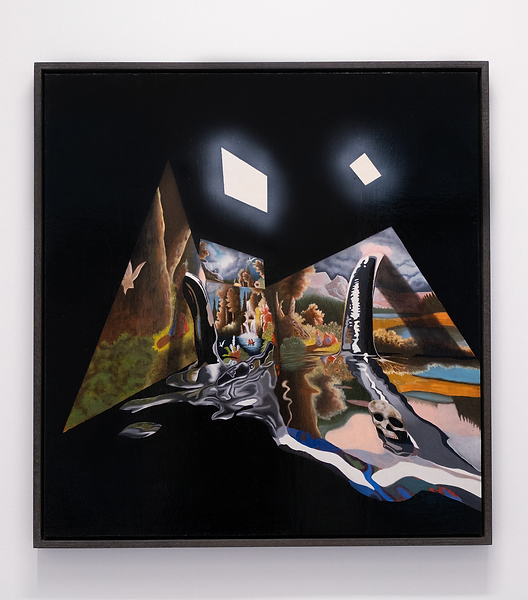
Clara Lou Villechaise
Résidus 2, 2025
Oil on wood
© Courtesy of the artist of Galerie Nicolas Salloum
Rémi, light in your sculptures feels less like illumination and more like disturbance, while Clara, your paintings seem to absorb light rather than reflect it. How does each of you think about light in your practice?
Light is both something almost magical and the physical outcome of a technical, programmed system. In my sculptures, when it appears electrically, I want it to signal or diffuse as little as possible as if, for once, it could refrain from helping us see clearly. Connected to a timer, it takes on a kind of autonomy, switching on and off on its own. It no longer responds to a need; it is the one that calls out to us. There is a reversal here between subject and object, in the sense Perec described regarding our use of things: we no longer watch television — it is television that, in turn, watches us.
In Perched Guardian, the two red diodes suggest an unsettling presence, something close to surveillance: a signal, a sense of monitoring. The light becomes a presence in its own right, like a living room clock whose familiar rhythm quietly structures the passage from day to night. And where my sculptures are generally characterized by a matte, colorful appearance, the Speaker series, through its glossy black glaze, shifts into a more dramatic register — here it is natural light, caught in the play of sinuous forms, that allows us to perceive the volume.
There is an obvious difference between Rémi's sculptures, enveloped in natural light, and my paintings, where light is represented through color, a trompe-l'œil, because the light itself is already a fiction. I wouldn't say my paintings absorb light, since almost all of them are varnished, a process I've been using only very recently for its formal qualities, but also to create a transhistorical surface that sits somewhere between digital screens and classical paintings on wood panels. There is a kind of mise en abyme at play: a circulation between the fluids invading the canvases, which through their glossy properties reflect light, and the mirror-like surface that the varnish produces. These spaces are bathed in a glow that recalls screens — something almost spectral, like a film set.
The publication conceived for this show brings together Bataille, Perec, Haraway, Levé, a constellation of very different voices. Which of those felt closest to something you were already thinking about in the studio?
This publication was conceived by Salomé Moindjie-Gallet, the writer and collaborator of Nicolas Salloum, as a parallel reading space for the exhibition rather than a map of our direct references. It wasn't meant to explain the works, but to accompany them through a constellation of texts and voices chosen to create echoes, frictions and unexpected connections. The presence of Bataille, Perec, Haraway or Levé reflects her curatorial and editorial sensibility more than our own influences. Each author opens a possible entry point into the works, but the selection was always Salomé's, an interpretive and poetic framework built around the exhibition, not a key to it.
Curatorial Note by Salomé Moindjie-Gallet
From 19 March to 14 May 2026, Galerie Nicolas Salloum inaugurates its first exhibition: Collant, poisseux, visqueux. The title refers less to a quality of matter than to the contemporary condition of forms — that which clings, overflows, persists, and resists any clean separation. Rémi Galtier's sculptures suspend function and unfold organic volumes, almost erotic in the Bataillean sense, while Clara Lou Villechaise's landscapes transform nature into a saturated simulacrum traversed by viscous and toxic flows, echoing Morton's notion of the hyperobject and Baudrillard's theory of the simulacrum. Brought together within a pared-down scenography, these works by emerging artists explore the friction between matter and image, between object and volume. Collant, poisseux, visqueux thus proposes a sensitive and critical space in which the gaze no longer merely observes: it comes into contact, it adheres, it is traversed by the energy and excess of the works.
About Galerie Nicolas Salloum
Founded in 2026, Galerie Nicolas Salloum is the fruit of a long journey, marked by numerous encounters and aesthetic discoveries. It draws its inspiration from its own hybridity, rooted between France and Syria, a source of plural and hybrid imaginaries. The gallery presents itself as a multifaceted space, dedicated equally to exhibition, reflection, and artistic research. It seeks to raise questions particularly those tied to the versatility of lived experience and conscious processes.
As much a contemporary art gallery as an artistic laboratory, it aims to promote a range of formats beyond the traditional exhibition model. The artists it represents are witnesses to a liminal space. Through their gestures, they trace the contours of an elastic world — an in-between populated by unstable, floating, ephemeral forms. By probing and deciphering this magma, they extract an unknown substance, malleable and still warm, invited to become matter and then object in our tangible world. In sharing their work, in confronting us physically with their creations, they invite us into the adventure of our own dreams.


_edited.jpg)


