

In Dialogue with Shuo Hao
HUILE DE VITRE
Galerie Derouillon | Paris September 3 – October 4, 2025

FVTVRIST Magazine //September 15, 2025
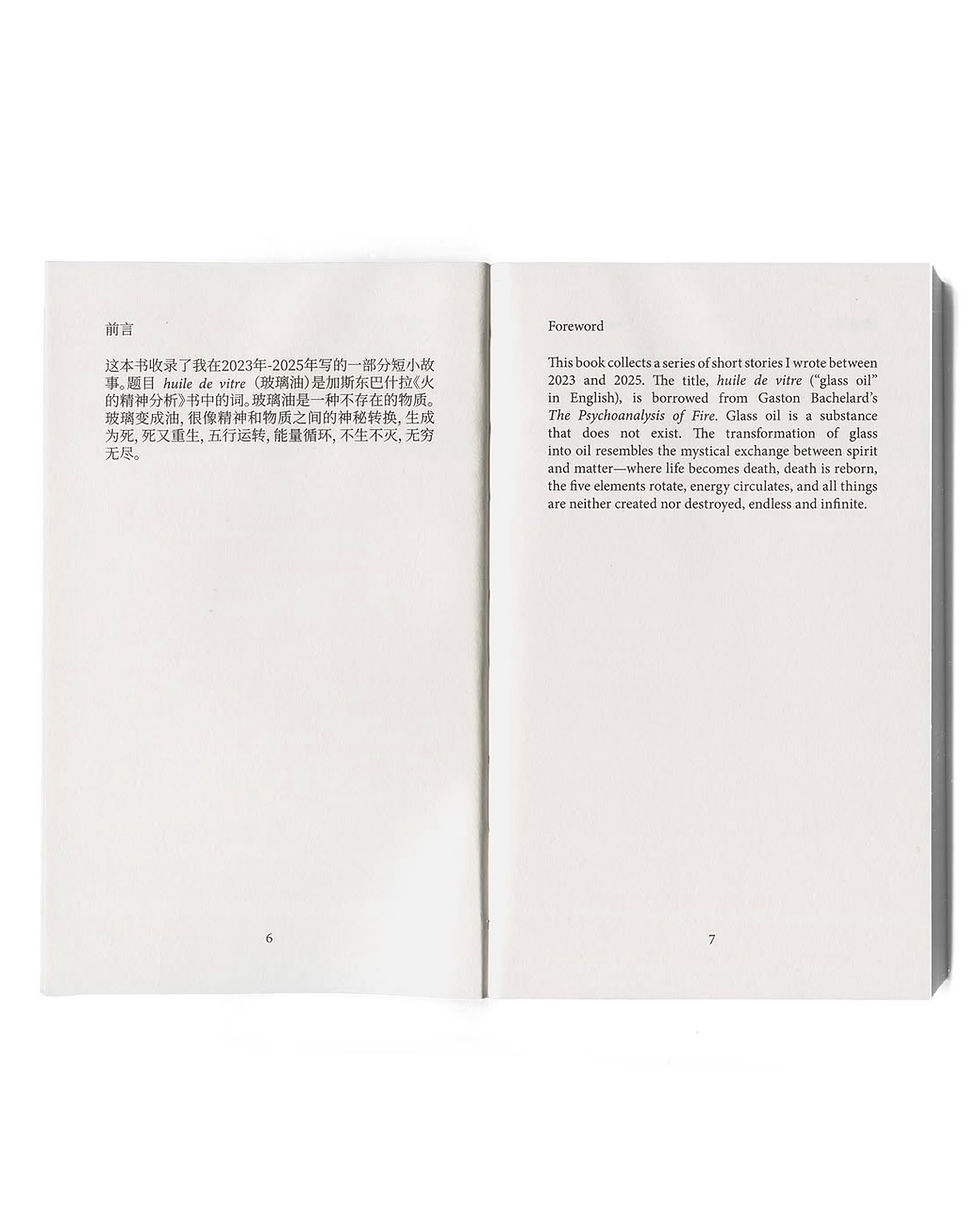
In Huile de vitre, Shuo Hao constructs a world where painting, poetry, myth, and ritual converge. Presented at Galerie Derouillon, the exhibition is inspired by Gaston Bachelard’s The Psychoanalysis of Fire, where glass was once thought to hold fire within it.
The artist transforms this belief into a metaphor for fragility and transmutation: objects that appear solid become fluid, thresholds open between visible and invisible, grief and healing, silence and light. Her works combine antique fragments, paintings, and texts written in her notebooks. The exhibition unfolds like a rite, shaped by the Yi Jing and its vision of perpetual transformation.
We met with Shuo Hao in Paris to discuss her creative journey, forms and symbols, and the future of her practice.
Shuo Hao, Image courtesy of the artist.

Installation view, Huile de vitre, Shuo Hao, Galerie Derouillon, 2025. © Gregory Copitet
Your paintings are accompanied by short texts, like parallel fictions. When you create, do you begin with words or with images? Where does the first spark of the work usually appear?
Words and images appear in parallel; there has never been a precise beginning. The first spark of a work usually arises from the unknown and intuition, from scattered fragments, and then gradually develops into stories.

You’ve described yourself as a shaman, an interpreter, someone who listens, gathers fragments, and invents. The fifty texts in Huile de vitre are another layer of meaning. How do these writings interact with your visual work?
Some of the texts are small mythological tales I created, directly corresponding to my oil paintings, often beginning with Greek myths. Other texts are fleeting impressions from life. I cherish those moments when multiple sensations intersect—I capture them as I would capture inspiration for painting.

The exhibition feels like a ritual space, more than a traditional display of works. Do you see yourself staging a rite for the viewer, guiding them through a passage rather than showing discrete objects?
Yes, what I arranged is a Five Elements space drawn from a purely Daoist system. I hope the audience can perceive a unique energy through the exhibition—an energy that merges the mystical undertone of Eastern religions with the sacred force of Western religions, forming a complete energy that unifies the world through integration and balance. During the exhibition, many people told me they felt an indescribable energy field, and that depending on their affinity for one of the five elements—wood, fire, earth, metal, water—they lingered longer in front of the corresponding works to absorb energy. This made me very gratified.

Shuo Hao, Cerbère + Protection, Galerie Derouillon, 2025. © Youna Virus
I wield metaphors to reveal the truth. Infinite metaphors.
There will always be one able to reach one’s heart.
A flash of light—not seen, but radiating from within.
You know you are this light.
Image courtesy of the artist.

Shuo Hao, La nuit de Démeter, Galerie Derouillon, 2025.

Shuo Hao, Iris la messagère | Sphinx sans énigme, Galerie Derouillon, 2025.

HUILE DE VITRE - SHUO HAO
HUILE DE VITRE - SHUO HAO

HUILE DE VITRE - SHUO HAO
HUILE DE VITRE - SHUO HAO
The Yi Jing imagines reality as cycles, shifts, and balance between opposites. How did this philosophy shape the way you composed the space of Huile de vitre?
I divided the space into eight trigrams, the fundamental symbols of the Yi Jing. Each trigram corresponds to the five elements—wood, fire, earth, metal, water—as well as the eight directions and the transitions between seasons. At each position, I placed works that embodied the corresponding element and story. Each work represents a deity from Greek mythology or a Christian martyr. I see the exhibition as carrying an intention of 'the return of the gods'.
The forms in your work: vases, candles, pomegranates, fragmented bodies, sphinxes, ouroboros snakes—seem to carry symbolic weight. What do these shapes represent for you, and what do they reveal that language cannot?
For me, these forms represent parts of myself. I often sense their presence within my body at a subconscious level. I feel that my flesh and bones are composed of these spirited objects and animals, each with its own mode of existence. In acknowledging this, I learn to respect my own body.
In Huile de vitre, fire is never explicit but seems to burn beneath the surface, hidden in glass, in silence, in wounds. How do you understand this invisible fire that runs through your work?
I have always been trying to articulate fire. My previous solo exhibition was purely about fire—filled with red and intensity. Later, I realized that the fire I was pursuing had always been within me. This exhibition contains almost no red, yet everywhere there is an invisible heat. It is an inner fire: the unwavering and ever-stronger conviction I hold toward creation and life.

Your works often incorporate found objects like antique tables, drawers, fragments of furniture. What draws you to these pieces, and how do you decide what role they will play once transformed into art?
I have loved old objects since childhood—writing in antique notebooks, searching for treasured relics at my grandfather’s home. I always wanted to make works related to old objects. In 2022, I encountered a blank wooden screen, and the moment I saw it, I knew it was meant for me. Since then, I’ve been seeking that same feeling—to recognize the old objects waiting for me. Once transformed into artworks, they begin their new life, taking on the missions of gods and rituals. Once forgotten in corners, they are now awakened again through my creation.

Shuo Hao, Offrande éternelle, Galerie Derouillon, 2025.
Mythological figures appear throughout your work: Persephone, Aphrodite, Actaeon, Zeus. Why do you return to these stories of metamorphosis and sacrifice? Do they mirror your own ruptures and transformations?
Yes, I see myself as someone who constantly seeks to break boundaries. These processes are full of struggle, yet they also carry a sense of destiny. Creatively, before I truly began working in oil painting, I had never studied it formally, my paintings gradually emerged from my explorations with pastels. I have also worked in home product design, jewelry design, illustration, and storytelling, and even published four children’s books in France. For me, meaning is found in existence through continuous transformation. The mythological stories I cherish resonate deeply with my inner experiences of rupture and change.
Huile de vitre is also marked by mourning - the loss of a close friend. How did grief enter into this body of work, and what role did creation play in carrying that memory forward?
When I had completed all the works and finalized the exhibition plan, one position still remained without a suitable piece. As I was hesitating, I received devastating news. I was crying on the phone with the triptych screen before me, and in that moment I decided to dedicate this work to my friend. The act of painting became a way of pouring all my blessings and longing into it—it carried a powerful force of intention. This piece is also the only complete male figure in the exhibition.
Installation view, Huile de vitre, Shuo Hao, Galerie Derouillon, 2025. © Gregory Copitet

Shuo Hao, Offrande éternelle bis, Galerie Derouillon, 2025.

Shuo Hao, Huile de vitre, Galerie Derouillon, 2025. © Gregory Copitet

Shuo Hao, Protection verso, Galerie Derouillon, 2025.

Shuo Hao, Sainte Agathe, Galerie Derouillon, 2025.

Shuo Hao, Huile de vitre, Galerie Derouillon, 2025.
The art world often looks for clarity and narratives. How do you balance this poetic language with the expectations of galleries and collectors?
From the very beginning, I have deliberately chosen to work with Greek myths and biblical stories, which give my narrative structure a clear foundation. Poetic language and Eastern philosophy form the underlying spirit of my practice—not directly, but as reflections within the stories I choose and the way I paint. I believe that only by finding balance within myself can I remain in balance with the outside world.
Looking beyond Huile de vitre, how do you imagine your future practice? Do you see yourself continuing to move between painting, objects, and writing, or opening toward new forms and new geographies?
I believe new forms emerge naturally through the process of working, just as with this exhibition, which I prepared over two and a half years as a crystallization of time and devotion. Everything presented took shape step by step. I will continue to create new works in accordance with my own rhythm and the true needs of my inner self.
FIN