

Courtesy MASSIMODECARLO.
Michelle Blade Presents Five New Paintings at PIÈCE UNIQUE, Massimo De Carlo Paris
In dialogue with Michelle Blade
FVTVRIST Magazine // 3 March 2026
Interview by Anna S.
From March 3 to March 14, 2026, Los Angeles–based artist Michelle Blade presents five new paintings at PIÈCE UNIQUE, Massimo De Carlo’s Paris space at 57 Rue de Turenne. Known for her luminous surfaces and psychologically charged atmospheres, Michelle Blade approaches painting as a site where memory, landscape, and lived experience converge with quiet intensity.
FVTVRIST speaks with Michelle Blade about transience and transformation, the inherited landscape of Southern California, motherhood as a perceptual framework, and the porous boundary between painting and language.

Installation views, 2026. Courtesy MASSIMODECARLO.
The exhibition unfolds in the intimate framework of PIÈCE UNIQUE in Paris. Does this concentrated format intensify a sense of vulnerability, or does it allow the work to assert a more independent presence?
There are five paintings in the exhibition for PIÈCE UNIQUE. I love the scale of and the way the picture window makes the work feel both exposed and protected, like a greenhouse. I appreciate the intimacy that it’s scale invites.
When you began Singular Bloom, what came first: an image, a memory, or a feeling you could not yet name?
The image came first. I saw the painting while running one morning in Altadena. I passed the yard of an apartment building that had become part of my regular route and on this particular day I was lucky enough to witness a cactus bloom that had opened overnight. These types of blooms appear suddenly, almost miraculously and disappear just as quickly. It was a gorgeous vision.
Flowers in painting often signal mortality as much as beauty. Is your bloom opening toward life, or already leaning toward disappearance?
Flowers always seem to live inside tension, straddling the realms of beauty, fragility, and death. Humans treasure flowers because we know their beauty is fleeting. Running toward the cactus flower that morning, I felt a demand for pause and presence, a moment to witness its fullness.
The flower stands alone, yet it never feels isolated. Is it a subject in your composition, or is it the atmosphere itself?Within a painting, the flower has the potential to become a vessel for the atmosphere around it. It can carry its environment; the paleness of an early morning, the stillness that exists within a busy city, or even a trace of the lives unfolding nearby. When I’m creating a painting I try to infuse the entire field with feeling, so the bloom is never simply itself.
You describe painting as something that unfolds over time. Did this work require long periods of return and revision, or did it arrive with unusual clarity?
A painting typically begins with a photograph and a series of drawings made from both the image and my memory of being there. Once the painting begins, the process starts to loosen and evolve. I work wet into wet, which means the paint has its own temperament. It moves, bleeds, and often resists what I thought I was doing. These moments of resistance are vital because they open the work up to a moment where intention and accident begin to collide. It is within that conversation that clarity emerges for me, along with a new poetic understanding of the image and the moment I am chasing.
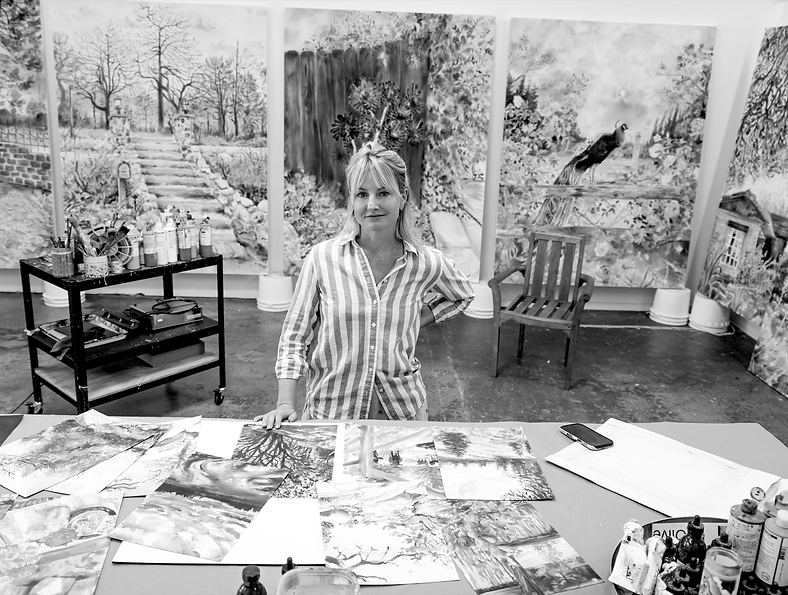
Portrait Michelle Blade © IMG Credit: Katie Shapiro l Courtesy of the artist.
Motherhood shapes your practice not as imagery, but as a way of seeing. Does Singular Bloom carry that tension between protection and release?
Perhaps it does. To care for anything is to understand that care cannot stop time. To protect what you love, whether a child, a landscape, or even a fragile bloom, means knowing you must let it move beyond you. The same is true for art making.
As a third-generation Angeleno, your relationship to landscape is inherited as much as observed. When you paint a flower, are you also painting memory and lineage?
Yes. When I paint the landscape here, I often feel I am painting a type of inheritance. My family has lived among these mountains and trees for generations. Their experiences and mine sometimes run parallel and sometimes diverge, but nature remains the constant touchstone.
Your work is often framed through intimacy and the maternal sublime. Do you feel this language truly understands your practice, or does it sometimes reduce it?
The images I paint come from quintessential, quotidian moments encountered while moving through the day. I think people recognize themselves in that familiarity. It reminds them that beauty and the sublime are held within the everyday.
When you move between painting and poetry, which comes first? Does language generate the image, or does the image call language into being?
I am first and foremost a visual artist. Words came much later to me in life. In a way language has become another material, another way of approaching the same questions I ask in paint. It allows me to speak in a different register and to say things I may have been too quiet to say before.


Installation views, 2026. Courtesy MASSIMODECARLO.
A SALUTARY SPRING
Gliding through the verdant
mess of tangled beauty,
the limb of time refuses
The vase precedes the compost
With the bedroom door cracked,
two horned owls call out in the blackness
discussing, considering, offering
The halftime show on the tv
echoes down the hall
As the wave-like din of a party rises and falls
God bless America(s)!
The present, unaware
of its solidarity with yes and no
attempts to sketch evolution.
Dormant seeds
already shedding their introversion,
stretch spellbound, towards conviction.
A dry crunch of a sycamore leaf
and the dog’s face presses into the screen.
Somewhere between restless and lazy
I too breathe in the smell of the damp
warm brick and night blooming jasmine
Mimicking, learning
She devoutly believes
In the infinitude of beauty
Spring is no sleep walker
About Michelle Blade
Michelle Blade (b. 1981, Los Angeles) is a Los Angeles–based painter whose work explores time, memory, and the persistence of the natural world through intimate, autobiographical frameworks. A third-generation Angeleno, she draws on Southern California landscapes, domestic interiors, and the lived experience of motherhood as structural elements within her practice. Working with acrylic and ink on cotton poplin in a wet-on-wet technique, Michelle Blade creates translucent, atmospheric surfaces where figuration and abstraction coexist.
Michelle Blade has presented solo exhibitions at Powerlong Museum (Shanghai), Loyal (Stockholm), Micki Meng (San Francisco), Asia Art Center (Beijing & Taipei), Wilding Cran (Los Angeles) and held group exhibitions at Marin MOCA (San Rafael, CA), Blum & Poe (Los Angeles), Robert & Tilton (Los Angeles), Simon Lee Gallery (London), The Bonnefanten Museum (Maastricht), Nassima Landau Foundation (Tel Aviv), Ju Ming Museum (New Taipei City), Xinjiang Art Museum (Urumqi, China), K11 MUSEA (Shanghai), WOAW Gallery (Hong Kong), The Torrance Art Museum, The Center for Contemporary Arts (Santa Fe), and Rachel Uffner (NYC).
About MASSIMODECARLO Pièce Unique
Massimo de Carlo Pièce Unique is a gallery space dedicated to focused, carefully edited exhibitions. Rather than presenting large-scale shows, Pièce Unique invites artists to concentrate on a small number of works and a single idea, allowing each exhibition to be experienced slowly and with attention.
The format encourages clarity and intimacy, creating space for one artistic statement at a time. By reducing scale and excess, Pièce Unique allows works to be seen more closely, and the artist’s intentions to remain clear and undiluted. It is a model of exhibition-making that strongly resonates with us.


