

DEL MARFIL
AL COLOR
HÍDALGO
A Dialogue with Clara Sánchez Sala
Save the date: NF/ NIEVES FERNÁNDEZ 11.09.25, Madrid
FVTVRIST Magazine // July 14, 2025
Clara Sánchez Sala is a Madrid-based artist whose practice moves between material research, embodied memory, and linguistic precision. Working across sculpture, installation, and writing, she brings together classical materials—bronze, ivory, silk—with substances drawn from the everyday: makeup and wax. This interplay between permanence and perishability grounds a body of work that is both formally exact and conceptually layered.
Her recent works consider the body as both surface and structure: photographs embedded in flooring, casts of nipples and navels, silk panels stained with cosmetics instead of paint. These gestures engage with the materiality of care and the visibility of feminine labour, framing the domestic as a sculptural and political space. Her titles—shifting between Spanish, Italian, and French—act as linguistic extensions of the work, nuanced and emotionally charged.
On the occasion of her upcoming exhibition at NF/Galería Nieves Fernández in Madrid, FVTVRIST speaks with Sánchez Sala about transformation, tactility, the domestic as sculptural terrain, and the ways in which a work, once released, no longer belongs entirely to the artist.

ARTWORK「 Del marfil al color hígado」
Mixed media installation : ivory, silk, cosmetics, light, 2025
Produced during the Matadero Madrid Residency
Your work often incorporates intimate materials—makeup on silk, ceramics moulded from your body, varnishes and pigments linked to specific studios. How do these sensory elements—touch, scent, texture—function as anchors of memory or autobiographical signposts within your practice?
I like to combine two types of materials: on one hand, those associated with sculpture in a more classical sense, or with art in general—such as bronze, iron, brass, various pigments, woods, or fabrics; and on the other hand, materials that are part of our everyday lives, like makeup, milk, wine, or bread. These latter materials are not considered "noble," but they are essential to our existence—or at the very least, we constantly turn to them. We all build memories around them. Many of these substances also carry powerful historical and symbolic meanings tied to human life, as is the case with milk, bread, or wine.
When I conceive a piece, I always start from a world I know very well, but I end up realising that we all inhabit a similar universe—and I like that—because the works ultimately belong to those who see themselves in them.
There’s a strange liturgical feeling in your use of hands, veils, muted flesh tones. Is there a sacred dimension in your work—even if it’s secular? What role does ritual play in your studio?
I don’t think there’s a sacred dimension in my work, but there is an ongoing concern with certain things that may seem mundane at first glance. Perhaps they’re so deeply internalized, so seamlessly woven into our daily lives, that we don’t question them. But when we do, new questions begin to emerge. I like to observe, to question, and to draw connections when I think.
When I begin to materialize an idea, I tend to establish certain rules that help me work physically. But even then, there’s always a dialogue between the material and what I have in mind. There has to be a negotiation—sometimes the material resists the transformation I want, and I have to choose another, or find a different way, or settle somewhere in between. I like that, because my pieces never turn out exactly as I first imagined them.
In 'Mettersi un velo davanti agli occhi' you draw a parallel between Saint Lucy’s iconography and make‑up as a cultural artefact that both conceals and transforms. On a personal level, when you apply cosmetics onto silk, are you reflecting on self‑perception or constructing a facade? Where do concealment and revelation meet?
Makeup, as such, isn’t a modern invention—pigments were already being used on the face and body in prehistoric times. For me, makeup is a mechanism of transformation, and as such, it reveals a great deal about the person wearing it. Adding something to the body always tells a story; it’s never neutral. In the act of covering, there’s also a way of revealing.
I often mix biographical data with milestones or dates from general history. This 'play' amuses me, and at the same time, it allows me to enter a spiral of questions that enrich my work. I believe art is visceral—it can be more or less emotionally charged, but it’s always authentic.

ARTWORK「Mettersi un velo davanti agli occi」
Cosmetics on silk, 280 x 200, 2025
Courtesy of the artist.

ARTWORK「La Dame à la Licorne. À mon seul desir 」
130x135cm, Cosmetics on silk, 2025.
Image courtesy of NF/ NIEVES FERNÁNDEZ Gallery

ARTWORK「Boceto para »Aplicar con los dedos para un efecto más fundente» (3) 」
30x50cm, Eyeshadow on paper, 2024.
Image courtesy of NF/ NIEVES FERNÁNDEZ Gallery


ARTWORK「Santa Águeda 」
Soap, silver, and steel, 970 × 25.5 × 25.5 cm, 2022
Images courtesy of artist

ARTWORK「Ofelia」
Botanical print on cotton, 97 × 88.5 cm, 96 × 69 cm, 2022
「Módulo para levantar columnas」
2021, Plaster, Variable dimensions
Image courtesy of the artist
Created in Matadero’s residency, this sculpture’s title speaks of a powerful color shift - from ivory to liver. What emotional or corporeal transition does this transformation carry for you? Was the Matadero context - a space of regeneration - critical to this piece’s emergence?
This title establishes a direct reference to two classical sculptural materials: ivory and bronze. On one hand, ivory evokes a symbolic relationship with human bone, not only because of its whitish and yellowish tones but also due to its history rich in bodily connotations. On the other hand, “liver color” refers to a specific patina applied to bronze in classical sculpture, known as hepatizon, which takes on a dark reddish tone similar to that of the organ from which it derives its name.
Both materials, in their tactile and visual qualities, seem to approach the idea of the body, as if trying to simulate vital presence from something inert. The title points to a symbolic transition from the inert to the living, recovering the mythical gesture of Pygmalion.

ARTWORK,「Labios de piedra, vestidos de carne」
Instituto Cervantes París, 2025, Image courtesy of the artist
The Residencias Matadero space was fundamental for this piece. I began the residency with a project exploring the intersection between the iconography of Saint Lucy — patron saint of sight — and makeup as a mechanism of transformation, questioning the tension between truth and artifice.
This initial investigation led to a new line of inquiry focused on the idea of incarnation: the technique in classical painting and sculpture aimed at giving the painted body a realism that seems to breathe life into the material.
Using makeup as a pictorial medium, I began to “incarnate” silks, intending to create a device similar to a ceiling lamp that would project incarnate light through fabrics dyed with blush, in order to illuminate an organic-shaped ivory sculpture.
The light, passing through the reddened silk, generates the illusion of life, of flesh, in the bone, giving it a corporeal gravity. Thus, the ivory, white and yellowish like bone, is deceived by the eye, which perceives it as flesh.
I finished the residency with a sort of “prototype” that gave rise to the exhibition I will have in September at the Nieves Fernández gallery.

ARTWORK,「Quand je ne dis rien je pense encore」
2025, Image courtesy of the artist
With the exhibition opening on the horizon: how does it feel to imminently release these works- your personal archives, your body’s imprints, your veils- into a public arena? What emotional, intuitive, or intellectual thresholds are you preparing to cross as a result?
I like releasing my pieces — that’s what I make them for. There’s always a before and after when an exhibition ends. Showing newly finished works helps me think about the next ones, because I can observe how they behave outside the studio, how the public receives them, what they provoke. At the same time, it allows me to take some distance: when the pieces enter the exhibition space, a necessary separation occurs. They no longer fully belong to me, and in that letting go, there’s a sense of relief — an opening.

By molding navels and nipples from your body, you expose personal icons of intimacy and reproduction. In turning them into ceramic objects, do they become relics, confrontational artifacts – or both? What does the translation from flesh to fired clay signify?
The body, time, and space are intrinsically connected—everything happens in a body, in a place, and at a specific moment. It’s impossible to separate any of those three elements. So when I mold parts of my body, I’m not just speaking about myself, but performing a gesture that inscribes something intimate into a material that gives it a different temporality.
Your black-and-white floor piece asks the viewer to literally walk over images. How do you feel about that unspoken contract: the moment of contact where the body acts on the image? Is this an act of liberation, erasure, complicity - or something more ambiguous?
This piece, which will be part of the exhibition in September, is designed for the viewer to walk on it, even though the footsteps may alter it. The work seeks to establish a parallel between the gestures of DIY and sculptural processes, positioning both as modes of making that operate through repetition, intuitive precision, and the transformation of the everyday.
The insertion of these images beneath the floor not only introduces a hidden visual layer that tensions the surface but also alludes to the invisible labor of care, repair, and domesticity, connecting the intimate space of the home with the public space of the gallery.
The use of images taken from DIY manuals—printed guides of practical knowledge—also allows for reflection on the material and artisanal dimension of artistic practice. Just as DIY proposes solutions through improvisation, assembly, and the use of available resources, art can also be understood as a space of intervention on what exists, where the given is reconfigured with precise, cumulative, and personal gestures.
In this sense, uniting these two worlds—the domestic repair and artistic practice—not only questions the hierarchy between crafts and disciplines but also reivindicates the poetic and political value of manual work as a form of thought.
Something unfinished is always a possibility,
and that deeply interests me.
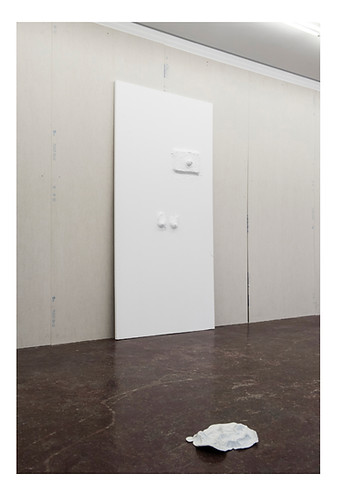

ARTWORK「Templo-Pladur II」
Plaster, Variable dimensions, 2021
Image courtesy of the artist
About The Exhibition
NF/ NIEVES FERNÁNDEZ 11.09.25, Madrid
Del marfil al color hígado is a sculptural installation that reflects Clara Sánchez Sala’s ongoing exploration of material transformation, embodiment, and perceptual thresholds. Conceived during her residency at Matadero Madrid, the work draws on the symbolic resonance of two classical materials: ivory and bronze. The reference to “liver colour” (hígado) alludes to hepatizon, a patina historically applied to bronze to achieve a reddish, organic tonality. This chromatic and conceptual shift—from ivory, associated with bone and stasis, to the visceral density of liver-toned bronze—signals a passage from the inert to the animate.
At the core of the installation is a dialogue between the sculptural and the corporeal. A suspended silk surface, tinted with cosmetic pigments traditionally applied to the skin, filters light toward an ivory-like form. This light, diffused through layers of blush and powder, produces the illusion of flesh—suggesting a moment of incarnation in which lifeless matter is momentarily animated. The act of applying makeup becomes both a gesture of care and a formal strategy, situating the cosmetic within a lineage of classical techniques that sought to give material the appearance of living tissue.
Del marfil al color hígado occupies a liminal space between historical reference and contemporary inquiry, between surface and substance, presence and artifice. It invites the viewer not only to consider the body as subject, but also as medium—constructed, imagined, and illuminated.
FIN