

© Courtesy of Christabel Png
SYSTEMS IN MOTION
In dialogue with Christabel Png
FVTVRIST Magazine
2 July 2026
FVTVRIST in conversation with Christabel Png on the occasion of RCA2026: School of Arts & Humanities Show in London. Her practice spans photography, installation, sound, and moving image, and in each of them beauty becomes inseparable from instability. Her silk prints hang between appearance and disappearance, holding a charged sensuality while refusing fixed perception, the image dissolves before it can settle into meaning. Beneath that surface runs a harder inquiry into systems, self-agency, and the psychological tension between visibility and concealment.
We spoke about defining a practice on its own terms, the one-way ticket out of Singapore, and blur as protection rather than loss. Png stages seeing as a shifting condition, never resolved, never the same twice.
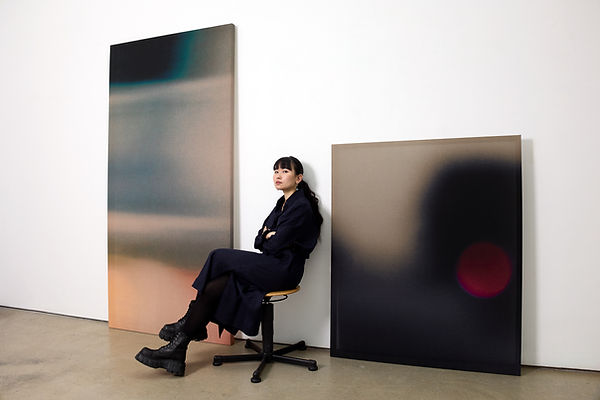
Christabel Png with Intermission and Dissociation, 2026.
© Courtesy of the artist.
You describe yourself as a systems artist. Setting the design career aside, how would you define the practice in your own terms, independent of the biography that tends to explain it?
While my biography informs the work, I see the practice less as autobiography and more as an investigation into how life is constructed within systems. Systems appear fixed, but are often more negotiable than they seem. Identity is one manifestation of that. Institutions, technology, and infrastructure are others. By destabilising familiar definitions, the work makes us more aware of our tendency to project biases onto what we encounter. It allows meaning to remain open rather than prescribed.
I test this proposition across different mediums:
Transforming a video of a traffic system into painterly fields of colour that resist easy medium categorisation. Using aesthetic beauty, allowing a work to appear innocuously decorative before an invitation into a sharper conceptual exploration.
Electronically composing a melodic song from a single note and its modulated layers. Creating a completely silent film with no narrative, so viewers construct their own. People often think of systems as abstract. They are not. We are the system. Us, and our machines. My work seeks to provide a counter-lens on the interpretation of systems, in a way that reclaims our freedom and agency. It explores how reality can be shaped beyond the limitations we inherit.
Systems are transformed through emotion and connection. Why else does anyone dedicate their energy to a cause? Softness, ambiguity, and intimacy can be ways to approach systems, qualities often neglected in the pursuit of optimisation and efficiency.


1/Intermission, 2026. Reactive dye on silk, stretched on pine,
215 × 106 × 4.5 cm.
2/Still in Transit, 2026. Reactive dye on silk, stretched on pine with legs of steel,
215 × 106 × 4.5 cm.
© Courtesy of the artist.

Between Us, 2025. Still from a silent short film.
© Courtesy of the artist.
Systems imply order; motion implies a way out of it. Your work holds both within the same frame. Is that tension the subject itself, or the condition the work depends on to exist?
My work examines constraints, and injects possibility. How do we know this thing we’ve accepted is true? Is it even a constraint?
Systems are not static. They are built by people, and are changed by people. Your presence influences it, no matter the position you occupy within, or outside of it. They are in constant motion, which becomes more apparent when we observe them across time and history. They shift as we shift, when individual choices accumulate into collective movement. The tension between order and fluidity is both the subject of the work and the condition inherent to it.
The silk, pixellated and alive with colour, is tensioned over a rigid frame. But it dances with you if you dance with it. Even though you do not touch it, it responds to your presence. Its translucency interacts with the environment. The image transforms through light and shadow.
Because of its photographic nature, even though its been abstracted beyond visual recognition, it holds data – of people who passed through the frame, the moment it was captured, the place it came into being, the technology that allowed it to happen. The digital translates into the physical, and back again. From one continent to another. There is no complete way out of systems. Exiting one system enters you into another, albeit with different conditions.
Self-agency within systems is the idea at the centre of the work. A system sustains itself by rendering the individual predictable, and agency is the refusal of that. Does the work propose that freedom within a system is genuine, or only its appearance?
I insist that we remain free. Self-agency within systems reflects human nature and free will. Systems simultaneously limit and provide access to the ways we can live, but they do not fully erase agency. We still make our own decisions, and face the consequences that follow.
We find familiarity and safety in belonging, but what happens when belonging becomes limiting? My work pushes past it. I often see people making choices that go against their own instincts, following processes they themselves do not agree with. At the same time, I’ve also helped significant change happen in ways people originally insisted were impossible — not through inherent authority, but persistence, curiosity, and influencing the right people within systems who hold the power to overturn decisions.
There can be a lack of emotional safety within the systems we belong to, even a lack of care that we provide to each other. We are often restrained by our own fear or ego. We wish to exceed our limits, but are held back by the belief that we can’t. It is easier to say we have no choice, than to confront the uncertainty and responsibility that choice carries. We never fully know what is possible until we try, and keep trying.
You left Singapore on a one-way ticket in 2024, with no fixed plan. Why London, and what were you leaving behind?
I wanted a big adventure of my own. I had become increasingly restless, and long considered relocating. Multiple aspects of my life collided. I had quit my job rather abruptly, and happened to have a flight to Berlin with no return booked. I left with the intent that I would figure out where to live, travelling across different places in Europe before I decided on London.
I didn’t leave public service because I became anti institutional. On the contrary, I still believe institutions are very necessary. But my interests have often been drawn towards the more relational aspects of systems, and the questioning of structures to improve them. In doing so I often find myself returning to questions of identity, belonging, and self articulation, which were not so easily explored within that role.
As a public servant, I was legally bound by the Public Service Code of Conduct to maintain outward political neutrality and could not publicly participate in critique of government policies, even when they intersected with my own lived experience.
As a childless single person, I am largely excluded from Singapore’s public housing system until after 35, as it is structured around married couples and families. It makes up 80% of residential homes. I didn’t want my access and belonging to be contingent on my relationship status.
I felt valued for my usefulness and efficiency in solving problems, but I wanted to make things that could speak to the emotional aspects of being human. Much of my work had focused on public services, digital systems, and national scale process redesign. I wanted to expand beyond that version of myself.
Leaving Singapore allowed my identity to be more fluid, because I could distance myself from what had been expected of me and the pressure of fitting in. I wanted to see who I would become if I removed everything that had formed my sense of self: my job, my home, my people, my belongings. I felt like I needed that separation in order to see myself clearly.
In some ways, a systems design experiment turned inward. To observe which parts of me were genuinely mine, and which had emerged in response to circumstance. A test, and a search for what remains when familiar definitions fall away. A conscious reshaping of my life to understand what all of it actually meant to me.
Singapore has inherited aspects of England’s systems too, which creates a real sense of familiarity despite the distance. London is less traditionally conservative, while still sharing many traits that Singapore carries, particularly its diversity and modernity. But here, there is greater emphasis and support for the arts, openness to individual self-expression and a stronger culture of institutional critique. It changed the conditions through which I could meet myself.
London has become home, but Singapore is also still home within me. My family and many of my friends, who include my ex-colleagues, remain in Singapore, and I continue to return to spend time with them.
I INSIST THAT WE REMAIN FREE. WE NEVER FULLY KNOW WHAT IS POSSIBLE UNTIL WE TRY, AND KEEP TRYING.
Two years on, how do you read London now? Has it entered the work, or does it remain the room in which the work is made?
I wouldn’t be making the work that I am now if I hadn’t come to London. I’m certain of that. I had left Singapore thinking that I would find another job in tech. But I wasn’t attending the tech conferences when I should have. I spent most of my time in nature, or in art galleries, museums, clubs and gigs. With artists and musicians. Scientists too, which does influence my work. And of course, people in tech and business still.
When I decided to take an MA in Contemporary Art Practice at the Royal College of Art, I started by making work that could translate my past and interests into this new context. London is the room in which the work is made, but also the reason it exists in the first place. Because I made it so that I could stay.
A photograph cannot become a painting. It retains the fact of a real moment, even once it has been fragmented and distorted past recognition. How do you work with that resistance, and is the dissolution an attempt to release the image from its own evidence?
I don’t think of it as resistance. I see it as transference, of data from one form into another. Acceptance. Permission to see differently, in a world that often tells us what we should see. Even if the idealised plan is impossible, celebrating the adventure within the journey and recognising its beauty.
Have you ever been so overcome with emotion that you barely register the world around you? Where you move through a place but lose sight of its detail? Everything you see is coloured by your own perception. This is the state I want to bring the work into.
Instead of releasing the image from its own evidence, you could say that I’m retaining it. Through magnification, pixellation becomes visible. Alone, a pixel may not seem like much. Each one might be a bit different. But its presence shifts the surrounding field of colour. Remove it, and a hole appears.
I’m less interested in what we usually see on the surface, than what goes on underneath. Not just how it works, but how it is felt. Between people, and in myself. So in my work, photographic abstraction registers as something closer to the essence of sensation and its transience. The way all things connect, beyond what is plainly visible. Transition, which has been a constant theme through all my work, holds dissolution. Where what we thought was certain no longer feels clear. The old falls away, the new emerges.
Blur is conventionally read as loss. In your work it operates closer to protection, the world held in the instant before it resolves into meaning. What does an image gain by refusing to resolve, and what is forfeited the moment it becomes legible?
Clarity often comes through deconstruction. Rebuilding a system requires us to first question it. Often that process begins in uncertainty, and we may feel out of depth. Refusing to settle too quickly into total resolution also means accepting that what we perceive as stability is itself sustained through constant cyclical loss. Systems repeat, though never in exactly the same way. This is how they are built, maintained and transformed.
An image gains emotional and psychological openness by refusing to fully resolve. The moment something becomes legible also carries its inevitable reduction. We categorise it, project onto it, and assume we understand all there is to it. Blur protects the image from solidifying too quickly into certainty. It allows it to hold contradiction and ambiguity simultaneously.

Dissociation, 2026. Reactive dye on silk, stretched on pine, 130 × 108 × 4 cm.
© Courtesy of the artist.

BLUR PROTECTS THE IMAGE FROM SOLIDIFYING TOO QUICKLY INTO CERTAINTY. IT ALLOWS IT TO HOLD CONTRADICTION AND AMBIGUITY SIMULTANEOUSLY.
Yellow Fever, 2025. Photographic self-portrait.
© Courtesy of the artist.
One question on where you come from, kept close to the work. You spent years making things legible for others; the work now resists being fully read. Is that a reaction against the earlier discipline, or the same instinct redirected toward something it can be honest about?
The two might seem contradictory: legibility and obscurity, but they are not. Both have their own place and function. One doesn’t obliterate the other. My work now isn’t a rejection of my earlier discipline. It is a deepening of it. An integration of my interests and concerns in a way that I wasn’t able to in the past.
I was honest in my work before, as I still am now. The difference is that here, I include the portrayal of myself. In design, clarity matters because people need to navigate systems, make decisions, access services, and understand information. Obscuring those things can create confusion, exclusion, or harm. But human experience itself is not always fully legible, neatly visible, or easily categorised. Emotion, personality, and identity often resist tidy definitions.
The underlying instinct in both practices has remained the same. I’m still interested in how we construct meaning, how perception shapes understanding, and how systems influence behaviour. Art guides imagination, design brings it into function.

Self Distortion, 2025. Photographic self-portrait.
© Courtesy of the artist.
Across the series, A Journey in Motion, After Contact, Reconstruction of the Self, In Transit, how do you see the practice having developed. What were you doing then that you have since let go of, and what emerged that you had not anticipated?
The titles probably reveal the trajectory quite clearly. I was searching for myself. I was allowed to work remotely, so over roughly four years I spent a significant amount of time moving through different places. Photography was a way of observing relationships: strangers, cities, moments of connection and disconnection.
I was studying how identity shifts depending on where we are, who we are around, and the systems we exist within. So I began pushing beyond photography as a depiction of what was immediately visible, and became increasingly interested in isolation, fragmentation, emotional ambiguity, and material translation.
It’s taught me greater acceptance of contradiction and flux. The possibility that identity is not fixed, but relational and continuously reshaped through context. I don’t think I can say that searching is fully resolved. I’m not sure if it will ever be. But I’ve stopped thinking of myself as someone who has to be fixed.
I’ve met individuals across very divergent paths in life. Politicians, dropouts, soldiers, refugees, chemists, addicts, millionaires, people living on the streets. Over time I’ve become more reluctant to believe there is a single way to meaningfully live. Multiple contrasting perspectives can be simultaneously valid within the same moment or experience. The longer I look, the more I see the nature of humanity. I didn’t anticipate how much those encounters would collectively impact me.
We met at the Biennale, your first. A biennale is itself a system, of attention, of value, of visibility. What did you take from it, and did it confirm something about the work or unsettle it?
I already understood that even art operated through systems of visibility, politics, performance, and power. The Biennale felt familiar even if on the surface everything looked different. More polished, more extravagant. Venice itself is raw and determined despite its decay. There were many different circuits. Lots of closed — but permeable doors.
I admired the shock and liberation, but what stayed with me were meaningful human encounters and genuinely heartfelt work, though they were perhaps considered quiet. I met people who took a genuine interest in my work, yourself included. Connections that have continued beyond Venice across multiple countries. It was my first time experiencing that kind of engagement within an international art context, which felt affirming. I enjoyed the social fluidity of the Biennale during the pre-opening week.
What I found to be especially interesting was how divisive and subjective art can be. There were works that some people strongly disliked or felt nothing for, which others loved, and vice versa.

Enter The Matrix, RCA 2026.
Christabel Png © Courtesy of the artist.
Was there a particular encounter, a work, a room, an exchange, that you are still carrying, and has it altered anything in what you are making now?
I find it difficult to trace the work to a single encounter. The series I’m currently focused on materialised from my departure from Singapore and the transition that followed, but it has also been shaped by countless exchanges across different places and periods of my life.
We do not exist in isolation, even if I’ve spent much of my time alone. I don’t think I would be the same person, making this type of work, if I hadn’t had those encounters. Some were joyful, some very painful. Most of those people are no longer with me. The best ones still remain. I find myself equally changed by good experiences and bad. Often what leaves a mark shapes us to be ready for the next thing.
That is why I’ve always been drawn to systems thinking in the first place. Seemingly separate events, people, and moments converge and diverge into movements larger than themselves. The work continues to be altered, not always literally, but through the ways they have moved me, challenged me, and changed how I understand myself and the world around me.
Many artists and researchers across industries have inspired me. I study their intentions and findings rather than replicating their methods and modes of application. Particularly in cognition, communication theory, neuroscience, and statistical mechanics. I’m interested in their personal stories, how it’s been translated into practice, and the way their work makes people feel or confront themselves within it.


Microcosm, 2025. Photographic abstraction.
© Courtesy of the artist.
You work deeply with music, and sound runs through the practice alongside the image. For many people music comes before the visual, the first thing they shaped a feeling around. Did sound come first for you, and does the work still carry that order, the listening underneath the looking?
I’ve never actually thought about the order to this before, but it is a good question. Music helps carry my emotion. From that place the visual emerges. In itself that creates a cycle. When I make an installation and compose a sound piece that is performed within it, I approach them separately. It’s hard to say which comes first, even if they become complementary. In the presence of an audience, they look and listen at the same time.
In my practice the visual work takes precedence over sound. I grew up playing music since I was four, but before that I learned to draw. I use both to communicate. To say what words cannot contain.
I like the way you describe ‘listening underneath the looking’, it does resonate but when I read those words, it’s not music and visuals that come to mind. Life itself. People, thoughts, feelings. Theirs. Mine. Nature. Machines. Infrastructure. A constant analysis of the world’s moving parts and how they all connect. Similarly, is it me who moves the crowd, or the crowd who moves me?
The Royal College of Art gave you a language for the work. Every language also determines what cannot be said within it. What did that training make available to you, and what did it quietly foreclose?
I wonder about this, because the RCA does not tell you what your practice should look like or say, nor does it teach a singular way of thinking or working. What it gives instead is space, and perhaps pressure, to decide who you are and what you actually want to make. We are encouraged to trust our audience, and to articulate the attributes of our work without having to spell out what it is about or resolve its meaning.
None of my questions about where the work or my practice should go were answered directly. We speak through critique and instinctive response. Technicians will not guide you unless you already have a plan. Tutors question you rigorously about your choices, your assumptions, and your references — rather than making you use specific methods, materials, aesthetics, words, or topics.
What the RCA made available to me was not language, but legitimisation to deviate from convention or tradition. To recognise that individuality, uncertainty, imperfection, and instability were not weaknesses in the work, but part of its strength.
At the same time, any institutional context inevitably shapes discourse through what it values, critiques, funds, or renders visible. All artistic languages risk becoming self-reinforcing over time. The task is to remain conscious of that while continuing to define my own position within it.
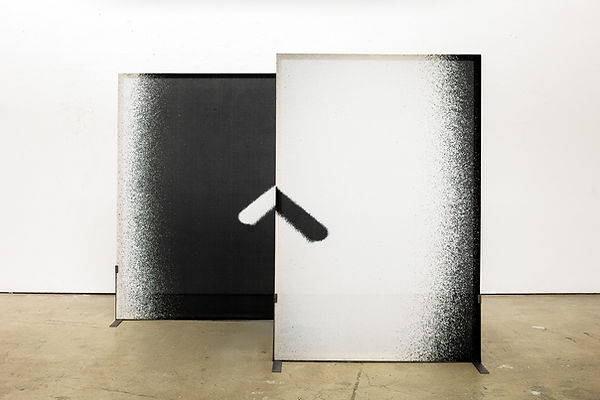
Held in Balance, 2026. Reactive dye on silk, stretched on pine with legs of steel, 180 × 120 × 4.5 cm each.
© Courtesy of the artist.
Tell us about the work you are presenting within RCA2026. Beneath the silk and the dissolution, what questions or conditions hold the exhibition together for you at this particular moment, and what does it mean to bring this body of work into public view now, at the point of graduation, in London?
Undefined by institution or role, just Christabel. There is no mould, no structure to disappear into. Only the world I have built around myself. Us, if you step into it. The series I’m presenting is titled A Journey in Motion. Space is limited, so I will only show select works.
The subject through which the images originate is traffic. Before leaving Singapore in 2024, I proposed a redesign of the country’s traffic system. The government is still continuing to develop it. These are fragments from videos I took, through a moving car when I was departing. The footage was terrible, but I’ve altered the images through colour, scale, and grain, while remaining faithful to what was originally present.
Abstraction opens multiple readings of the images, while retaining the captured event as a trace of a lived moment and the people who passed through. Everything visible in the silk was latent within the image. Even when I could not yet see it.
The images are digitally printed onto silk with reactive dye, in response to my Singaporean-Chinese heritage, femininity, metamorphosis, and histories of trade and labour in global circulation. It escapes the limits of what we’ve decided that an image should be. It is soft and delicate, but its not meant to be just placed upon a wall. I’ve built it to stand tall. Held upright on legs of steel. Defined by its own internal structure.The silk is translucent, and each image transforms through both light and shadow. Depending on the scale of the pieces, how wide I frame them, they shift gently as people pass.
It is that interaction that I want. To show the impact of our presence on systems. If art is a portrayal of the world that we live in, then the system that I exist within, holds beauty in ambiguity. Emotionality and sensitivity. A refusal of the definitions that have been prescribed for us. Traffic is philosophical to me. On the road we are all on our own journeys, though our paths may diverge. There are dead ends and U-turns. Still, there are always redirections. The destination is not fixed, even though I know where I want to be. The questions have changed since I first began. Their form has evolved alongside them. I’ve spent much of my career offering questions. This time, I would prefer the audience bring their own, and meet me here.

Entanglement, 2026. Self-portrait, digital photograph.
© Courtesy of the artist.
Christabel Png shortlisted for the Jaguar Awards 2026
Christabel Png has been named to the 20-strong shortlist for the second edition of the Jaguar Awards, run in partnership with the Royal College of Art. The selection recognises A Journey in Motion, a work in which fragments of filmed traffic are printed onto silk and built into freestanding forms, fragments of movement reassembled into sculptural metaphors for transition and emotional flux. The piece extends Png's wider practice, which turns her background in public sector system design into a personal inquiry, using art to locate a sense of self outside institutional roles.


Christabel Png with Intermission, Still in Transit, and Held in Balance, RCA 2026.
Artist portrait.
© Courtesy of the artist.
About Christabel Png
Christabel Png (b. 1993, Singapore) is a systems artist working across photography, installation, sound, and moving image. Her practice centres the emotionality of human experience and self-agency within systems, approaching identity as something continuously negotiated through perception, encounter, and projection. Through fragmentation, magnification, and distortion, clarity dissolves, allowing a single moment to hold multiple conflicting perspectives, none fully contained by what is seen. Her recent work prints images onto silk with reactive dye, where image and substrate become one with no boundary, and onto archival paper, where pigment rests on the surface, attached to tradition while retaining its separateness. Bodies of work include A Journey in Motion, After Contact, Reconstruction of the Self, and In Transit. She studied at the Royal College of Art and lives and works in London.


_edited.jpg)


