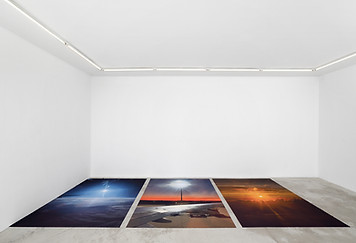
OVERGROWTH:
The Body As a Network
In dialogue with Andrea Samory
FVTVRIST Magazine // Text by Anna S.
24 April 2026
Overgrowth arrives before its explanation, because it names a condition rather than a form: a system exceeding its own logic, where growth detaches from origin and the boundary between the natural and the constructed dissolves. For Andrea Samory, it marks a shift from image to structure, asking what remains of the body once the virtual becomes its internal logic. The Infection series introduced the language, the Chimera series extended its scale, and Overgrowth brings them into continuity, at the precise moment when the body, as Samory sees it, has run out of places left to hide.
FVTVRIST spoke with Andrea Samory about this transition, as well as material, mythology, and the evolving relationship between body and virtual form.
Overgrowth © Courtesy of Andrea Samory.
3D Animation by Daniel John Paul, Instagram: @normalrender
STATEMENT
Andrea Samory’s approach to art employs familiar yet uncanny images to create a mirror for collective fears and expectations towards the future. He combines animation, 3D sculpting and 3D printing with SFX sculpting techniques, to materialize virtual images and tropes. In his work, the philosophies of Speculative Realism and Assemblage Theory get infused into the genres of Sci-Fi, Body Horror, Cosmic Horror and Magical Realism - a narrative created as a response to nowadays incessant flux of both dystopic and utopic information regarding global society, climate, politics, technology. His vocabulary takes advantage of shiny, soft and colorful materials to attract the viewer into a world of natural corruption and uncannyness, provoking the ambivalent feelings of repulsion and fascination, alienation and familiarity, recognition and corruption. This approach takes inspiration from how virality (both as a biology-related concept and an internet-related concept), and intangible forces in general, shape our everyday lives.
The recurring themes of growth, entropy, mythology and human hybris are given shape through the recombination, aggregation, distortion, and assemblage of natural textures and figures. He combines 3D sculpting and 3D printing with SFX and more traditional sculpting techniques, to attract the viewer into a world of natural corruption and uncannyness.

Andrea Samory, portrait © Courtesy of the artist.
You've lived in Tokyo for eight years now. You worked with Kengo Kuma, with Kohei Nawa. Japan influenced you long before you arrived, though. You grew up in Italy in the nineties.
Very much. My art tries to be a mirror for the collective fears and anxieties we hold towards the future. And Japan was feeding European children all of that, through sci-fi, dystopian, cyberpunk media. The aesthetics, the obsession with identity between the body and machines. I responded to that from a very young age without fully understanding why.
You've spoken about 1995 as a pivotal year. Why that year specifically?
Growing up with your identity completely tied to your physical body, and then being exposed to media that treat the body as interchangeable, as an accessory, something that can be upgraded, transferred, stored in the cloud. When you encounter that at five or six years old, it completely rewires the way you see yourself. I love the tension that exists between your human evolutionary biases, instincts, emotions, hormonal fluctuations, gut microbiome, anything body-related that shapes who you are and how you behave, versus virtual, ephemeral, algorithmic, machine-driven, interchangeable, crystalline environments.
And now, thirty years later?
Now it's even more extreme. I was sketching something by hand the other day and I had this impulse. Where is the undo button? I literally looked for a back button on paper. That's not a joke. My brain is now hardwired with the assumption that there is always a way to reverse. The boundary between my body and my devices has become almost meaningless. They are an appendage in the truest sense, not something you hold, something you are.

Signal 1.1 - Deposition, 2023, concrete, resin, silicone, hair, 41x44xh11cm
© Courtesy of Andrea Samory.

Installation view, Wan Gallery, Art Central 2024.
Chimera 1.6, 2024, 3d printed resin, lacquer, pigments, 189x156x270 cm
© Courtesy of Andrea Samory.


1/ Infection 2.1 - Assemblage
2/ Chimera 1.4
3/ Signal 4.1 - Serpent
4/ Signal 1.1 - Deposition
© Courtesy of the artist.
That dissolution is the engine of the Infection series. Where did the image come from, the capsules, the spores, the substrate?All of my work is about the relationship between virtual environments and the body, but each series approaches it differently. The Infection series is specifically about social media and virtual environments as systems. The Signal series is about identity and pattern recognition, gestalt. The Chimera series is about mythology. With Infection, I wanted to materialize the moment in which virtual environments physically start to affect your body and the way you act, without you noticing it.
The image I kept returning to was the visual language of the digital world, those capsule-like geometries, the rounded, shiny, friendly shapes that dominated app design and UI throughout the 2010s. That aesthetic was designed to feel safe and legible. A friendly facade for something enormously complex and insidious lying underneath. Like the pretty colours a fungal infection might display from the outside. And I noticed those shapes also resemble spores, or bacteria. Like mold. Like formations you see under an electron microscope. So I started placing them, these cold, virtual-looking capsules, onto biological substrates, letting them grow like something natural. The sculpture is both a fungal infection and a social network. It is the same image.
The series is now evolving into 'Overgrowth'. What shifted?I sometimes talk with Kohei Nawa about my work, and he made an observation that really stayed with me. He pointed out that Infection, especially translated into Japanese, carries a very specifically medical connotation. It always feels like something bad for the human. But because at the core the series is about creation and its consequences, he was saying - maybe find a term that feels more relational. When you're infected, it can be bad for you, but good for whatever is infecting you. So instead, you could shift the attention from the host/guest relationship, to the concept of endless growth itself. That is a very post-human way of thinking about it.
So Overgrowth feels more appropriate. And formally, I'm changing the shape of the elements, making them more like things that are actually sprouting out of the biological substrate, rather than sitting on top of it. Like horns that grow so much that they may end up piercing the very skin they had originally sprouted out of. I love the concept of “uncontrolled growth that may end up hurting its own host and ultimately itself” as a metaphor for the systems that surround us at large. How late-stage capitalism and neoliberalism act in such a contorted and recursive way.
I also want to make each material register more distinct. The biological parts more biological, the virtual parts more virtual, the machinic parts unmistakably machinic. I have so many different techniques across my series and I want to start combining them more deliberately within single pieces.

Andrea Samory, portrait © Courtesy of the artist.
In the Chimera series, the creatures can evoke contradictory emotions, at once unsettling and unexpectedly gentle. Is this balance something you consciously engineer?
My natural instinct, and I always try to resist it, is to go towards hyper-real detail. I'm really drawn to the visceral. I look at surgical imagery, microscopy photographs, electron microscope scans of bacteria and spores, and I find them genuinely beautiful. I've had to deliberately train myself to look at all that material and then abstract it rather than just reproduce it. I call it abstract hyperrealism: hyper-real in the texture and the feel, but never in the complete figure. In Infection it's about finding a pattern that feels hyper-real without ever revealing the whole organism. In the Signal series it's very hyper-real but just the smallest detail. In Chimera, I always try to make something figurative that is simultaneously the most abstract figurative form you could imagine.

Installation view, Overgrowth, Andrea Samory.
© Martin Holtkamp.

Installation view, Overgrowth, Andrea Samory.
© Martin Holtkamp.
Does Tokyo still feel like the right place for your work? How do you envision your future as an artist?
Living here has always been because of how much I feel at home.
But as an artist, especially in the past couple years, it's getting more difficult to really connect with fast-paced conversations around Zeitgeist. In the last two or three years I focused very much on Asia - Hong Kong, Korea, Taiwan, Japan. But this year I focused my exhibitions around Western countries – especially Central Europe.
What I'm finding is that the younger generation there is producing work that is materially experimental in exactly the direction I care about. Probably because of a genuine revival of the posthuman and transhuman aesthetics of the ‘90s and 2000s, but also because the broader public is now very well versed in discussions around identity online and sci-fi dystopian narratives.


THOSE CAPSULE-LIKE GEOMETRIES, THE ROUNDED, SHINY, FRIENDLY SHAPES THAT DOMINATED APP DESIGN AND UI THROUGHOUT THE 2010S WERE A FRIENDLY FACADE FOR SOMETHING ENORMOUSLY COMPLEX AND INSIDIOUS LYING UNDERNEATH. MY SCULPTURE IS BOTH A FUNGAL INFECTION AND A SOCIAL NETWORK. IT IS THE SAME IMAGE.
Something significant happened with the large work at Art Central in Hong Kong.
I watched people looking at that sculpture and realized that meaning is truly just made by people. And because mythology is so ingrained in human nature, depending on where you come from you will attach something a little different to that shape. But still, there are these archetypes everywhere in the world: the big predators, the hawks, the snakes, that people were obsessed with before they even invented agriculture. Things hardwired so deep into our evolution that recognizing them was literally a matter of survival. I really love connecting that, the way in which our evolutionary biases operate, with how we build and use virtual environments today. The tools have changed. The instinct has not.
Your work has always been about growth that corrupts, myths built around anxieties too large for us. Where does that come from personally?
I grew up as a very skeptical kid. I've never really believed in God or religion. But at the same time, as a kid, I felt the urge to believe in something to process things larger than life. It's just human nature. So I used to obsess over documentaries about cryptids, crop circles, folk legends, all that nineties material about things we can't explain. And nowadays I just love thinking about how there is this huge ongoing production of new legends, new lore, new ridiculous spooky stuff. Not because anyone needs more of it. But because even if we don't actually believe it, it's in our nature to create a new mythology for new anxieties. And the more anxious we are, the more we're going to keep creating these characters, these memes, these creatures.
Especially nowadays when irony is absolutely everywhere. There's always a tension between the genuine desire to create something bigger than yourself, and the memes, the stupid stuff, the self-aware detachment. Because we know we can't believe earnestly anymore. We're always a little bit removed. But we still need what's underneath that. We still need the myth.
You've started making fashion pieces. For someone working at monumental scale, that is a radical shift in intimacy. What happened? Is it a parallel practice or is it pointing somewhere new?
I'm a fan of Vito Acconci, someone who kept flowing into whatever medium his research naturally would lead him into. He started with poetry, then performance art and film, then installation, culminating into hyper- experimental architecture and industrial design - all around the body and identity.
And because of my obsession with the body, I've always followed the most experimental people working at the intersection of fashion and art. Originally I was thinking only about pieces for performances at my solo show, but I kept sketching and realized some of them could be developed into production pieces. Around the middle of last year I thought - I might actually already have the skills to do this.
I had worked on stage and costume designs before – a theater project I really loved working on is “Planet” by Damien Jalet and Kohei Nawa. So I was already familiar with some specific 3d sculpting software and fabrication techniques. I loved to get very technical about production.
I'm building it as its own brand, also called Overgrowth. The concept is the same: things growing from the body, the materialization of a posthuman relationship with virtual environments. I'll have very experimental pieces; jewelry, headpieces, large body pieces in limited editions.
Overgrowth, Andrea Samory.
© Courtesy of Andrea Samory.
3D Animation by Daniel John Paul, Instagram: @normalrender

A major solo in 2027. What do you want it to say that nothing you've made yet has managed to say?
I'm still working on it. But one thing I keep thinking about is the 3D printing itself, not just what it produces, but the medium. There's a technique I use where I make silicone molds from FDM prints, and the layer lines, those visible strata of the filament leave their imprint in the silicone. That imprint stays in the final piece. And I find that significant.
In a hundred years, FDM printing might look like something from a museum. Some early consumer grade machines already feel super antiquated. But that specific error, each unique trace left by the machine, it will never be exactly reproduced. Every print is unique in a way the digital file is not. The file can be stored and replicated forever. The object carries the moment it was made. Cogs get worn down, plastic expands and contracts while being melted, materials deteriorate over time. The more technical you get about fabrication in any medium, the more you realize how silly it is to act as if “machine production = infinite and perfect reproduction”.
Benjamin wrote about the aura in the age of mechanical reproduction, but that essay is almost a hundred years old and was written with film media in mind. The questions are completely different now. The 3D model is infinitely reproducible. The physical object made from it is not. I'm really interested in that gap. I think the 2027 show is somewhere in there.

Installation view.
Chimera 1.7, 2024, 3d printed resin, lacquer, pigments.
3D Animation by Daniel John Paul, Instagram: @normalrender.
© Courtesy of Andrea Samory.
About Andrea Samory
Andrea Samory is an Italian visual artist based in Tokyo. Born in 1991 in Italy. After studying in Belgium and UK, he obtained his Masters in Architecture with a thesis developed at the University of Tokyo under the supervision of Japanese architect Kengo Kuma. After working as a Teaching Assistant in the Kuma Lab and designing installations under Kengo Kuma and Associates, he worked as 3D artist, stage designer, installation designer and project manager for the Japanese artist Kohei Nawa, and his creative studio Sandwich Inc.
After opening his sculpture studio in Tokyo in 2021, and exhibiting his first solo exhibition in Tokyo in 2023, he has been exhibiting regularly in Asia and Europe. He has been featured in shows in Italy, Germany, France, The Netherlands, UK, Japan, Australia, Taiwan, Hong Kong, South Korea, and has displayed his work in universities such as Princeton,US; UTokyo, Japan; CEPT, India; AA School, UK.


_2025_102%20x%2091%20cm_1.jpg)